Trichocereus werdermannianus / Echinopsis werdermanniana
Trichocereus werdermannianus, also known as Echinopsis werdermanniana, is a columnar Trichocereus species from Bolivia. It is a close relative of Trichocereus terscheckii and I consider it an intermediate species between the large Andean...
Trichocereus werdermannianus / Echinopsis werdermanniana

Posts mit dem Label Backeberg werden angezeigt. Alle Posts anzeigen
Posts mit dem Label Backeberg werden angezeigt. Alle Posts anzeigen
Mittwoch, 28. November 2018
Trichocereus werdermannianus / Echinopsis werdermanniana Trichocereus werdermannianus / Echinopsis werdermanniana Trichocereus werdermannianus, also known as Echinopsis werdermanniana, is a columnar Trichocereus species from Bolivia. It is a close relative of Trichocereus terscheckii and I consider it an intermediate species between the large Andean... https://trichocereus.net/?p=1911

Freitag, 4. November 2016
Trichocereus grandiflorus / Echinopsis grandiflora
Trichocereus grandiflorus / Echinopsis grandiflora
Trichocereus grandiflorus is a cactus from the genus Trichocereus. Its current status is highly questionable and the opinions are as varied as the names it carried.
Synonyms: Lobivia grandiflora, Lobivia grandiflorus, Helianthocereus...
Trichocereus grandiflorus / Echinopsis grandiflora
Freitag, 22. April 2016
Trichocereus tarmaensis
Trichocereus tarmaensis Rauh & Backeberg – Deser. Cact. Nov. 20. 1956
Trichocereus tarmaensis is not an accepted species. It was described, but the whole species wasn´t really good to begin with due to the close relationship to Trichocereus cuzcoensis and other species like Tr. ...
Trichocereus tarmaensis
Samstag, 27. Juni 2015
BK10511.1 Trichocereus vollianus, between Arani & Rodeo, Cochabamba, Bolivia
BK10511.1 Trichocereus vollianus, between Arani & Rodeo, Cochabamba, Bolivia
Copyright: Ben Kamm, Sacredsucculents.com
This is a very interesting plant and there arent so many descriptions available about it. This plant was encountered during the 2010 field trip. I am not sure if the ID is correct but I´ll add the description now and maybe we can get to the bottom of it. This plant has a lot of similarities to Trichocereus Lamprochlorus, which grows in Cochabamba in Bolivia too. The original description of this plant came from Backeberg in his book KAKTUS-ABC. The original typus location was said to be Arque in Cochabamba. The shoots have a maximum diameter of up to 10 centimeters, approximately 13 ribs and a very bright green yellow color. The epidermis of this plant has similarities to Trichocereus Spachianus, which has a very bright green color too. The ribs are 7 mm broad and are up to 5 mm high. The areoles are approx. 2-2,5 cm apart from each other. The plant has 7-12 radial spines and very fine and thin spines that can get up to 7 mm long. There usually is only one middle spine which can reach a lenght of 2,5 cm. All spines are yellow colored (Backeberg used the term “Amber”).
Flowers: The flowers of Trichocereus Vollianus are white and up to 12 cm long. However, I assume that the flowers depend greatly on the health of the plant and larger flowers wouldnt come as a surprise to me.
Fruit: Green and very hairy.
How to keep it apart from Trichocereus Spachianus?: Trichocereus Vollianus is very similar to Trichocereus Spachianus but thicker, even more shiny and has a brighter green epidermis. Backeberg also mentioned that they work very well as a grafting stock.
There also was a Trichocereus Vollianus var. Rubrispinus with reddish spines, which would probably be regarded as nothing but a local form under modern taxonomy. I encountered populations that had all kinds of forms growing together and this kind of stuff isnt really enough to justify a new species. I own a plant that I suspect to be Trichocereus Vollianus and I will post some pics of it soon.
Where to get seeds of Trichocereus Vollianus?: Well, it´s definitely a rare species. Sacred Succulents collected some seeds and gave them away under the name mentioned above but apart from that, there are very few sources that provide VIABLE seed. I still have some Seeds from Köhres but couldnt get them to germinate. Succeed had them every now and then and it´s worth a try to ask Sacred Succulents because they probably grew some from the seeds they collected. You could also make a posting in our Trichocereus Facebook group because I know of some people who were able to get some seeds back when they were sold by Sacred Succulents. Definitely an interesting plant!
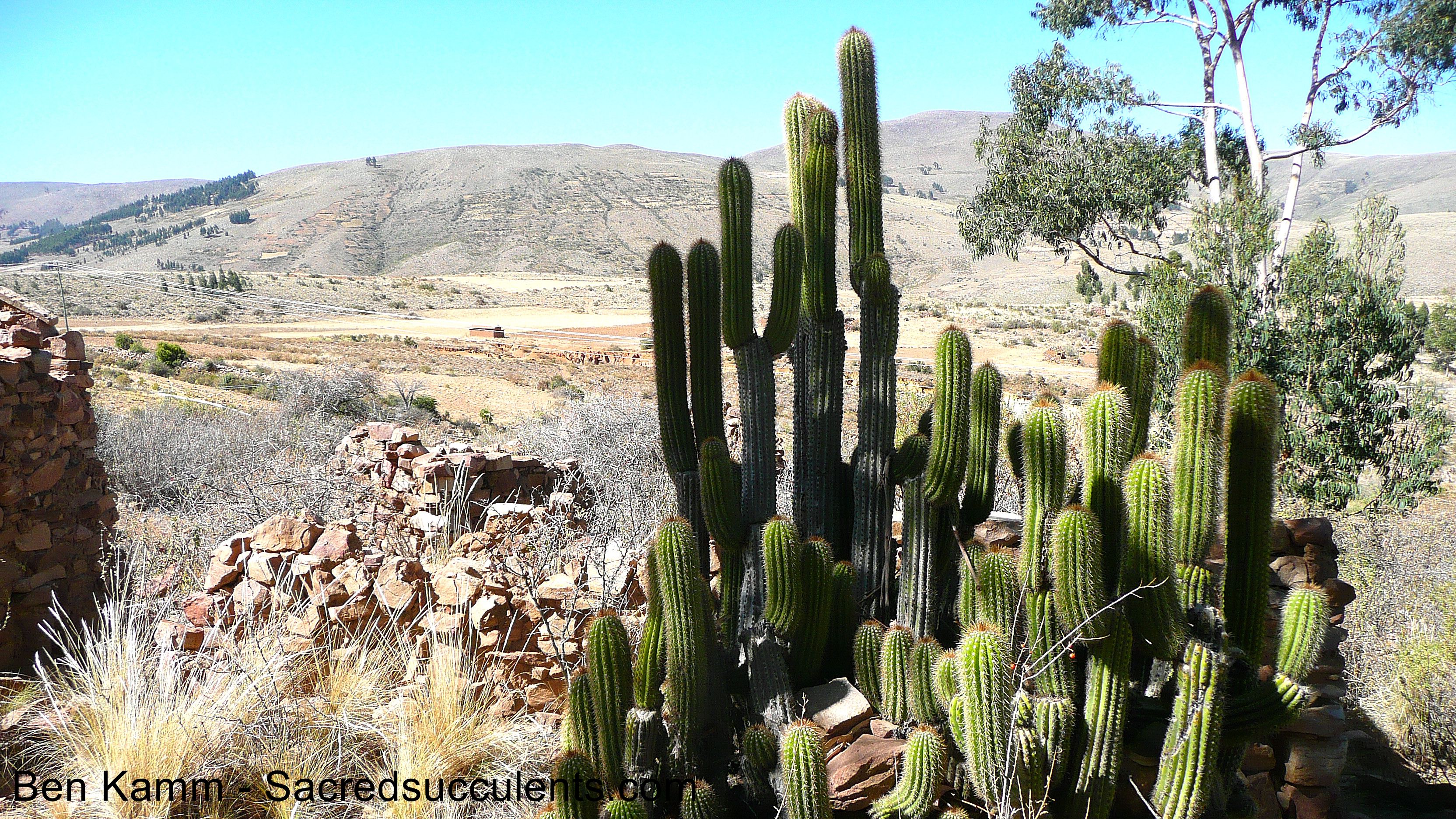
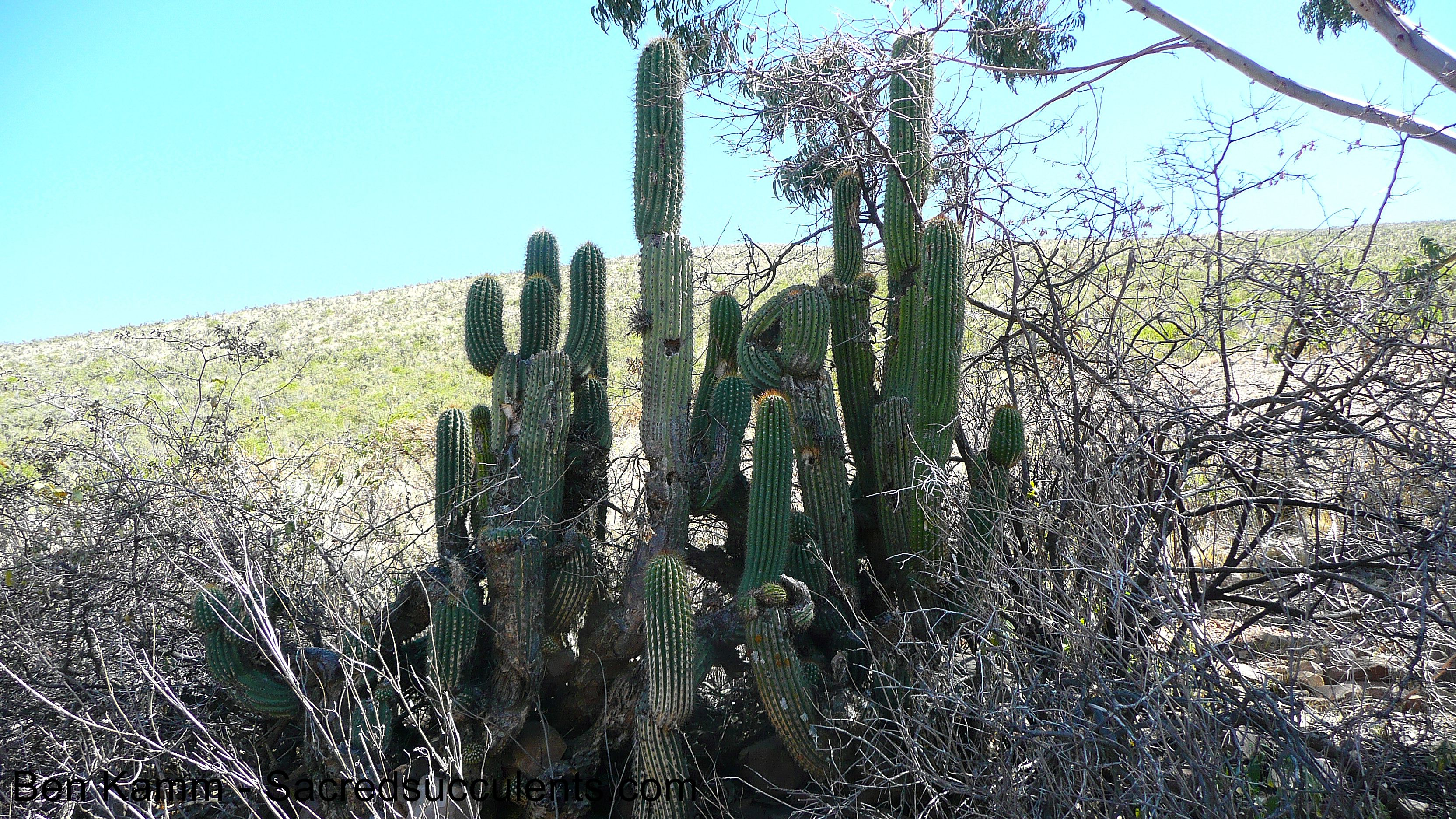

BK10511.1 Trichocereus vollianus, between Arani & Rodeo, Cochabamba, Bolivia
BK10511.1 Trichocereus vollianus, between Arani & Rodeo, Cochabamba, Bolivia
BK10511.1 Trichocereus vollianus, between Arani & Rodeo, Cochabamba, Bolivia
Copyright: Ben Kamm, Sacredsucculents.com
This is a very interesting plant and there arent so many descriptions available about it. This plant was encountered during the 2010 field trip. I am not sure if the ID is correct but I´ll add the description now and maybe we can get to the bottom of it. This plant has a lot of similarities to Trichocereus Lamprochlorus, which grows in Cochabamba in Bolivia too. The original description of this plant came from Backeberg in his book KAKTUS-ABC. The original typus location was said to be Arque in Cochabamba. The shoots have a maximum diameter of up to 10 centimeters, approximately 13 ribs and a very bright green yellow color. The epidermis of this plant has similarities to Trichocereus Spachianus, which has a very bright green color too. The ribs are 7 mm broad and are up to 5 mm high. The areoles are approx. 2-2,5 cm apart from each other. The plant has 7-12 radial spines and very fine and thin spines that can get up to 7 mm long. There usually is only one middle spine which can reach a lenght of 2,5 cm. All spines are yellow colored (Backeberg used the term “Amber”).
Flowers: The flowers of Trichocereus Vollianus are white and up to 12 cm long. However, I assume that the flowers depend greatly on the health of the plant and larger flowers wouldnt come as a surprise to me.
Fruit: Green and very hairy.
How to keep it apart from Trichocereus Spachianus?: Trichocereus Vollianus is very similar to Trichocereus Spachianus but thicker, even more shiny and has a brighter green epidermis. Backeberg also mentioned that they work very well as a grafting stock.
There also was a Trichocereus Vollianus var. Rubrispinus with reddish spines, which would probably be regarded as nothing but a local form under modern taxonomy. I encountered populations that had all kinds of forms growing together and this kind of stuff isnt really enough to justify a new species. I own a plant that I suspect to be Trichocereus Vollianus and I will post some pics of it soon.
Where to get seeds of Trichocereus Vollianus?: Well, it´s definitely a rare species. Sacred Succulents collected some seeds and gave them away under the name mentioned above but apart from that, there are very few sources that provide VIABLE seed. I still have some Seeds from Köhres but couldnt get them to germinate. Succeed had them every now and then and it´s worth a try to ask Sacred Succulents because they probably grew some from the seeds they collected. You could also make a posting in our Trichocereus Facebook group because I know of some people who were able to get some seeds back when they were sold by Sacred Succulents. Definitely an interesting plant!
BK10511.1 Trichocereus vollianus, between Arani & Rodeo, Cochabamba, Bolivia
Montag, 27. April 2015
Trichocereus Santaensis
Trichocereus Santaensis
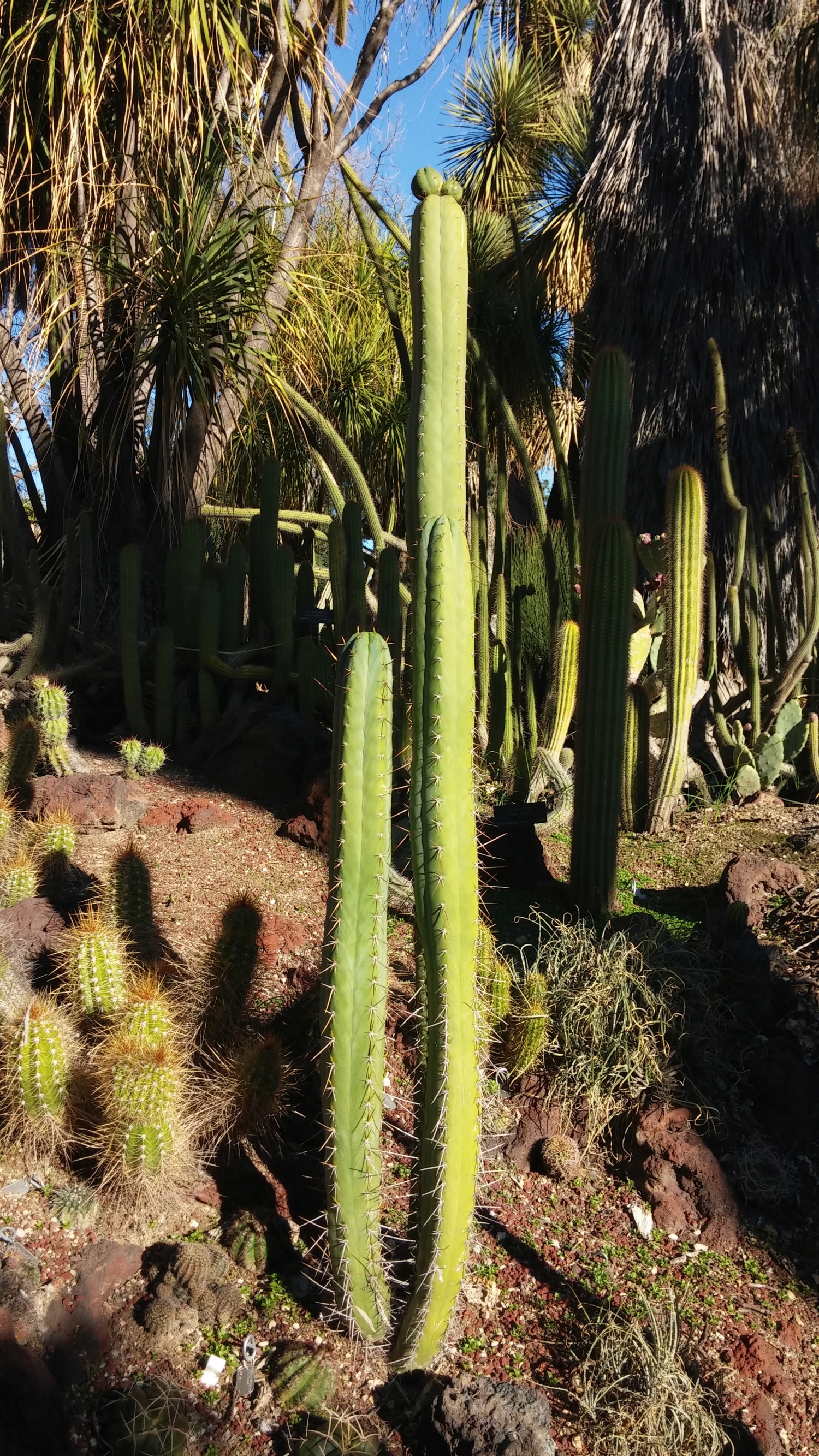
Trichocereus Santaensis is probably some kind of Trichocereu Peruvianus Variety with reddish Spines. Please note that the Descriptions we add here are just the Opinions of the Authors. Backeberg tried to name the Plant with his Friend Rauh and thought that Santaensis deserves to have the Rang of a Species and was the Opinion that is is different enough from TRICHOCEREUS PERUVIANUS, TRICHOCEREUS MACROGONUS and TRICHOCEREUS PACHANOI.
Origin: Northern Peru, the valley around the Rio Santa, Puente, Bedoya, Huayanca
Can be kept apart from Trichocereus Cuzcoensis by the lack of a base on the spines. It´s also more frosted blue, has less spines and shorter middle spines. Unlike Trichocereus Peruvianus, it grows always upwards and does not bend over. Please note that Trichocereus Santaensis is a Variety of Trichocereus Peruvianus. The cactus botanists were arguing about this species and the pics I have show different kinds of plants.
Description: Trichocereus santaensis Rauh & backb g -. Descr. Cact. Nov. 20, 1956
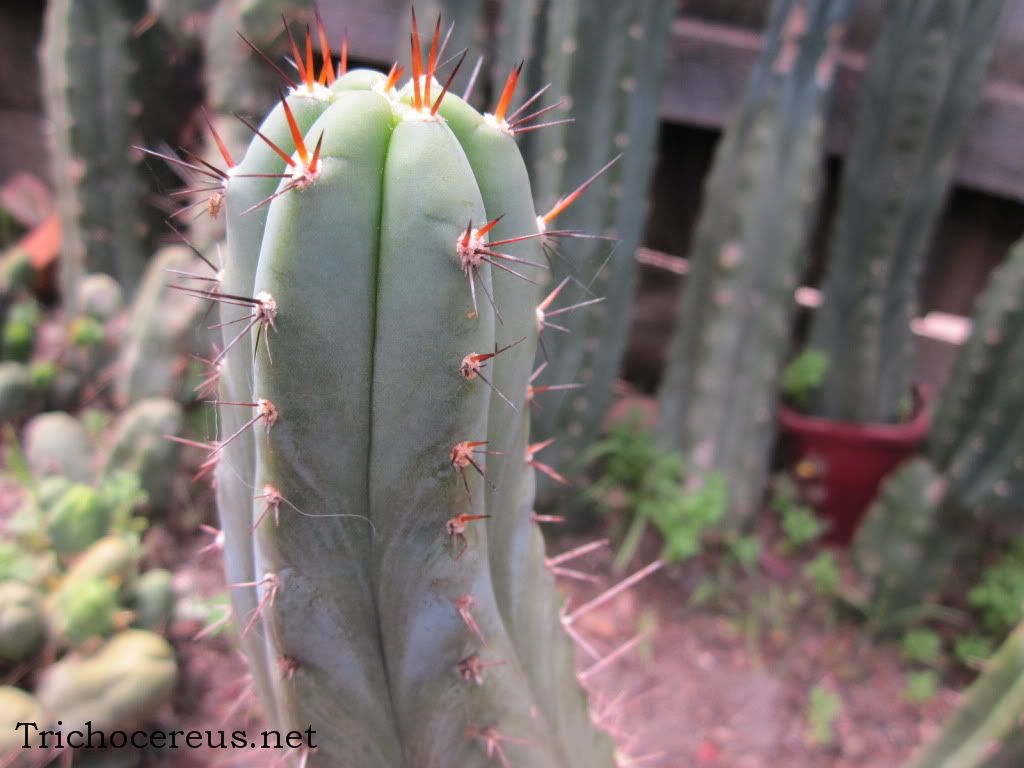
Trichocereus Santaensis can get up to five meters high and branches from the bottom. The stemps are blue-green to a glaucous green. It has 7-9 ribs that are similarly broad than the ones on Trichocereus Knuthianus aka Echinopsis Knuthiana. There is a distinct furrow above the areoles. This distinct V-Notch is very strong in young pups. The areoles have a diameter of approximately 1 centimeter and Trichocereus Santaensis has between 1-3 radial spines. Spines medium long to short. In addition, Trichocereus Santaensis has one very long middle spine, which is up to 5 centimeters long.
Flower: The flower is white and gets up to 22 centimeters in length. It has a similar flower than other San Pedro types, which is another indicator that Trichocereus Santaensis is probably just a variety of Trichocereus Peruvianus, Trichocereus Cuzcoensis or Trichocereus Macrogonus. The flower tube dark gray to brown hairs.
Origin/Habitat: Rio Santa, Puente, Huayacana, Bedoya.
Trichocereus Santaensis is said to be very similar to Trichocereus Cuzcoensis, but does NOT have rounded, knobby spine bases. Besides, the spination is less strong and grows always columnar instead of creeping. Today, it would be regarded as a Variety and not a species. Differences like slightly different spination do not justify describing it as a separate species.
Please note that there are some types of Trichocereus Santaensis that have red spines. Because of that, it´s a very sought after plant.
In the Chapter of TRICHOCEREUS PERVIANUS, Backeberg wrote about its growth type:
I even found the Type initially growing erect, then lying or hanging . But near Matucana, there also are upright growing Varities of Trichocereus Santaensis, which probably weren´t recognized as a seperate Species.
The identification of these species with Tr. macrogonus (KKDE., 20, 1941) i cannot agree with.
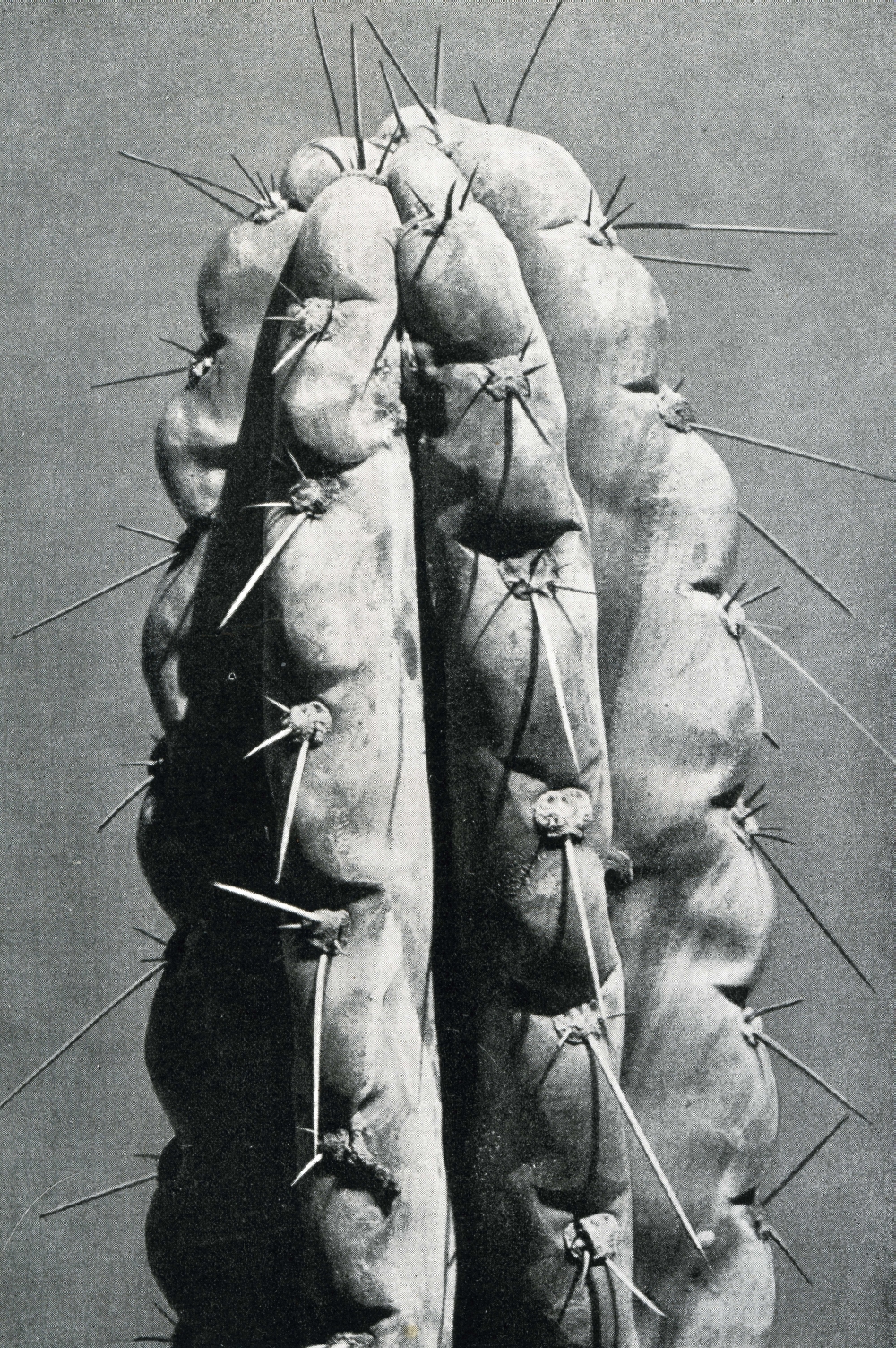
This is Backebergs Key for Trichocereus SantaensisBranches to 10 cm ∅
Blue green shoots
Ribs 7, very broad, strongly furroved,
Not flattened furrows
Spines gray-brown, brighter towards the base
Middle spines:
1 spine is longer, spines up to 4 cm long.
- Friedrich Ritters Description was:
Trichocereus SANTAENSIS RAUH & BACKBG. 1956 RAUH: BEITRÄGE PERUANISCHER KAKTEENVEGETATION
1958, s. 361
Differences from TR. Pachanoi (data for the latter in parentheses):
Body gray-green (grass green to bluish green). Ri. 6-7, usually 6 (5-8, in
Peru medium to 10 and even higher), on the Areoles a slight v-shaped
Notch (little cross notch). Ar. 3-5 mm Dm
Spines: few or absent,Rsp. to 3, a few mm to 3 cm long,
Middle Spines. usually one, often it is the only Spine, a few mm to 4 cm long.
Flower. Near the apex, about 18-19 cm long, about 12 cm wide open (up to 20 cm wide between the
outer petals), obliquely upward (about protruding horizontally), just
(with two slight curves). Nectar Chamber 19 mm long (slightly longer), without
significant gap (small space), with little or no
Nectar (with some nectar). Tube about ca 6 cm long with 2.5 cm further
Opening (longer and wider). Petals slightly shorter and narrower, the outer
almost adjacent to the interior Ones (strongly bent outwards),
SANTA Valley at 2000 m and about Depart. Ancash; only here. No. FR 567a.
Fig. 1,188,


Trichocereus Santaensis
Abonnieren
Posts (Atom)