Trichocereus riomizquensis (Ritter)
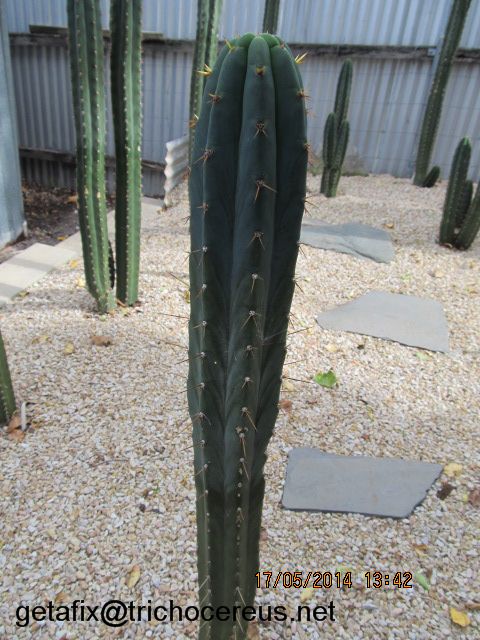
Trichocereus riomizquensis is a Bolivian Trichocereus closely related to Trichocereus bridgesii. It is a regional form of T. bridgesii that only endemic to one site in Bolivia near the Rio Mizque.
The species was discovered and described by the German cactus...
Trichocereus riomizquensis (Ritter)

Posts mit dem Label Trichocereus Bridgesii werden angezeigt. Alle Posts anzeigen
Posts mit dem Label Trichocereus Bridgesii werden angezeigt. Alle Posts anzeigen
Sonntag, 6. November 2016
Trichocereus riomizquensis (Ritter)

Freitag, 15. April 2016
Trichocereus bridgesii in Bolivia
Trichocereus bridgesii in Bolivia
Trichocereus bridgesii is probably THE dominant Trichocereus species in Bolivia. Yes, there are others but this species pretty much reflects the Bolivian counterpart of the Peruvian San Pedro cactus. The populations usually get up to 4-5 meters tall and form large groups. This plant is probably one of the most drought resistant Trichocereus species, which it manages to survive even the extreme temperatures in the Bolivian desert.
The Californian Nursery Sacredsucculents.com visited some regional populations of Trichocereus bridgesii in their Field Trips and I am extremely glad to have them here on the website. All photos are from Ben Kamm.
You can read the full version of this article on our page. It includes lots of photos:
https://trichocereus.net/echinopsis-lageniformis-trichocereus-bridgesii-bolivia
BK08603.3 Trichocereus bridgesii & BK08603.2 Prosopis alba, Huachjilla
This plant is very similar to the ones labeled Trichocereus aff. pachanoi. You can definitely see why so many people say that Trichocereus pachanoi grows in Bolivia too. They are extremely similar and it takes a lot of time and effort to differentiate them. The plant grows beside Prosopis Alba!
BK08608.2 Trichocereus bridgesii, mutant Achuma, NE La Paz, Bolivia
Another plant from the Sacred Succulents Field Trip 2008. A mutated version of an Achuma cactus that is just mindblowing. This is the type of thing that you can only encounter in nature. Those amazing walls of cactus are probably some of the most impressive sights that you can come across.
BK08608.3 Trichocereus bridgesii,NE La Paz, Bolivia
It comes from the same site as the BK08608.2 Trichocereus bridgesii, but from a different Plant! The BK08 means that it was visited by Ben Kamm in 2008. The later numbers are either labeled BK09 or BK10. There also were some plants that were visited during the 2014 Field Trip, which were labeled BK14. Those plants are dark green and very similar to what is understood as San Pedro. The flowers are covered with white hairs, which is a great way to keep it apart from most of the Peruvian San Pedros.
Does Echinopsis pachanoi grow in Bolivia?
Does Echinopsis pachanoi grow in Bolivia?
There are many mentions of Echinopsis pachanoi cactus in Bolivia. But much unlike popular belief, most of those plants are actually spineless varieties of Trichocereus bridgesii. Though both species can be very similar under certain conditions, you definitely see the difference on flowering plants. Echinopsis pachanoi often has brown or black hairs on the flowers, while the hairs on the Bolivian species are often white. This is not always the case, but sometimes.
Here are some of the Bolivian Trichocereus populations that were visited during Sacred Succulents´Field Trips. Most of the plants are labeled Trichocereus aff. pachanoi, what stands for „affinity to Trichocereus pachanoi“. That means that those plants look similar to Trichocereus pachanoi, while they probably are more closely related to Trichocereus bridgesii. Don´t forget that Echinopsis pachanoi is widely cultivated in every South American country today. It´s just that the Bolivian version of it is Trichocereus bridgesii. It is sometimes called Cactus of the four winds. The latter has become a catchy marketing phrase for everything that has four ribs, but that has more to do with marketing than ancient history. Nonetheless, this phrase has been used for a four-ribbed Bridgesii type. With that said, many plants can temporarily have four ribs, but usually grow some later on.
Here I will show some photos from the Sacred Succulents Field Trips from Bolivia. All those pics are from Ben Kamm and Sacredsucculents.com. Please support them to make more Field Trips like those possible!
Check out the full article with photos here: Echinopsis pachanoi in Bolivia
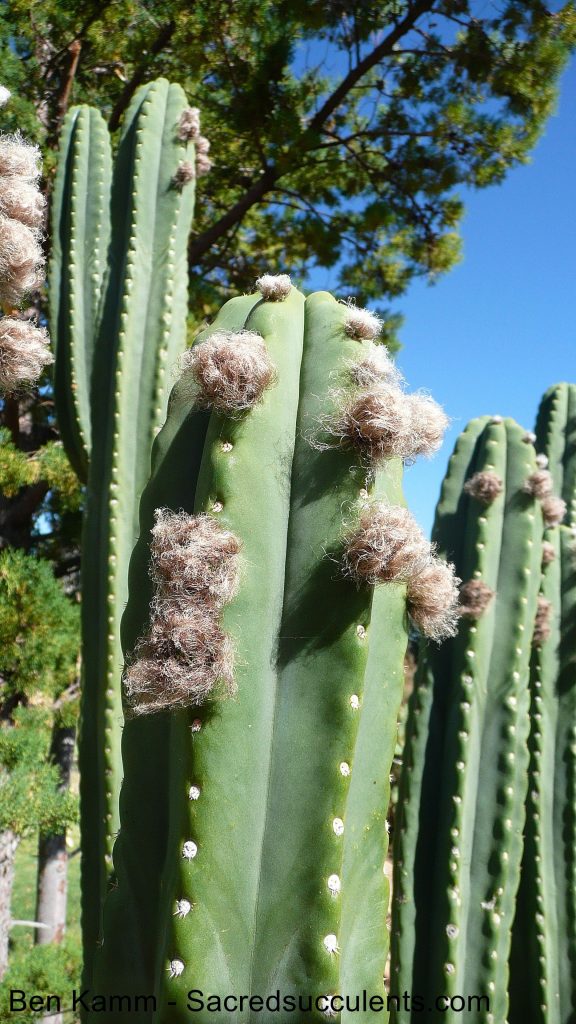
BK10512.11 Trichocereus aff. pachanoi, near Cuchucunata, Cochabamba, Bolivia
Those plants are relatively spineless, but look pretty typical for Bolivian plants between Trichocereus pachanoi and Trichocereus bridgesii. In my eyes, those are just spineless or relatively spineless forms of Trichocereus bridgesii but you would need to take a look at the flowers to verify. There certainly are some cultivated Pachanois in Bolivia, but they are grown as natural fencing or garden plants are did not evolve over time. Most populations of the San Pedro cactus in Bolivia are actually Trichocereus bridgesii.
Trichocereus aff. pachanoi, Arani, Cochabamba, Bolivia
On this one, you can see the obvious relationship to Trichocereus bridgesii. I originally wrote that it might be related to Trichocereus scopulicola, but it could as well but just another type of Trichocereus bridgesii. But the labeling with aff. pachanoi fits pretty good, though those are all closer related to Trichocereus bridgesii than they are to Trichocereus pachanoi.
BK10508.5 T. aff. pachanoi, Tiatako, Cochabamba, Bolivia
Another version of the San Pedro cactus in Bolivia. This one is the most interesting, because it might actually be a relative of Trichocereus scopulicola. But I would need to take a closer look at the rest of the plants. On the second pic, the ribs look very much like the ribs on a Trichocereus scopulicola.
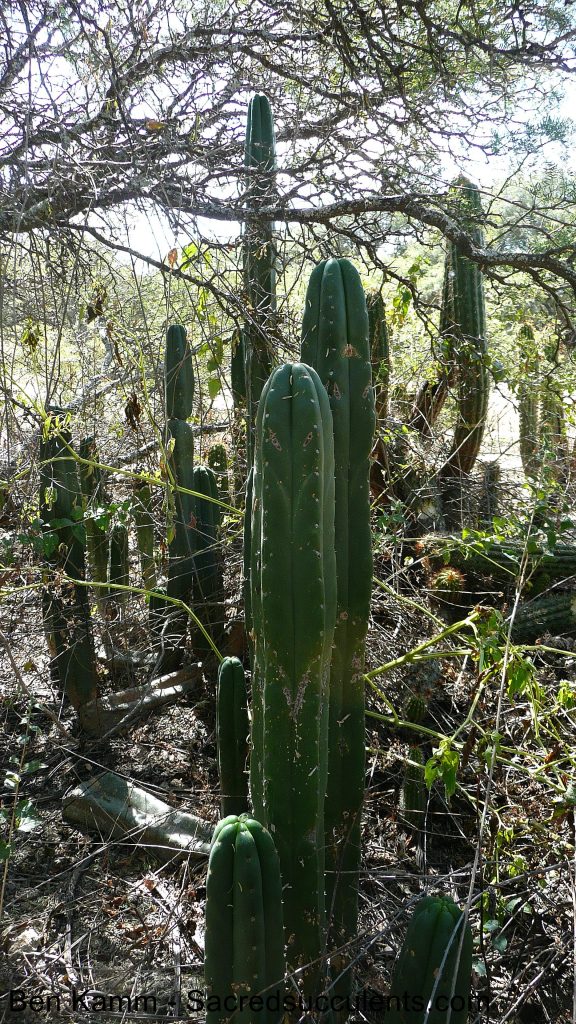

BK10508.1 Trichocereus aff. pachanoi, Cerro San Pedro, Cochabamba, Bolivia 2010
Trichocereus bridgesii, Martin Cardenas Botanical Garden, Cochabamba, Bolivia 2010
Trichocereus aff. pachanoi, Martin Cardenas Botanical Garden Cochabamba, Bolivia 2010
Very cool Trichocereus growing in Martin Cardenas Botanical Garden in Cochabamba, Bolivia!
Trichocereus species in Martin Cardenas Botanical Garden Cochabamba, Bolivia
Martin Cardenas is a specialist on peruvian cacti and this is his botanical garden in Chochabamba. He is widely accepted and respected field botanist and it´s really great to see his private garden.
Freitag, 1. April 2016
SS02 (Trichocereus bridgesii)
SS02 (Trichocereus bridgesii)
SS02 stands for a certain clone brought into cultivation by Ben Kamm & his nursery Sacred Succulents. It is a relatively short-spined Trichocereus bridgesii that is known to produce some mind-boggling offspring. Most of the hybrids produced with this plants do not look like a standard Bridgesii and due to the fact that Sacred Succulents has been offering them for years, there is a huge number of different SS02 Hybrids available.
Here is an excerpt of Sacred Succulent´s description of their SS02:
Dense candelabra stands to 16´tall. Blue/green frosted stems up to 5″ in diameter with 5 – 7 ribs. Each areole bears 2 – 4 central spines up to 1.5″ long. White nocturnal flowers. The new growth on old stemps is often spineless. A distinct form of Trichocereus bridgesii. Cold hardy to 25° Fahrenheit.
The Pictures of the SS02 clone were provided from Nitrogen!


And here are some hybrids that were created with the SS02 clone! If you want to some cuttings or seeds of the SS02, check out the Sacred Succulents website and ask for their seed list. There will be more SS02 hybrids to be seen in my upcoming book SAN PEDRO HYBRIDS.

(SS02 x Tr. peruvianus) x Tom Juul´s Giant / Photo: Noah Reams


(SS02 x Tom Juul´s Giant) x Tr. peruvianus / Photo: Noah Reams

Left: (SS02 x pachanoi) x TPM Right: TPM x SS02
Sacred Succulents used the SS02 to produce an endless list of great hybrids. Some of those are:
SS02 x SS01, SS02 x Trichocereus pachanoi, SS02 x Huancabamba, SS02 x BBG, SS02 x Luther Burbank, and many more. Apart from Sacred Succulents, the SS02 is used bymany other breeders, such as Misplant, Cactusaffinity.com and many more.
SS02 (Trichocereus bridgesii)
Samstag, 12. März 2016
Crowdfunding Campaign TRICHOCEREUS VOLUME 1
Crowdfunding Campaign TRICHOCEREUS VOLUME 1
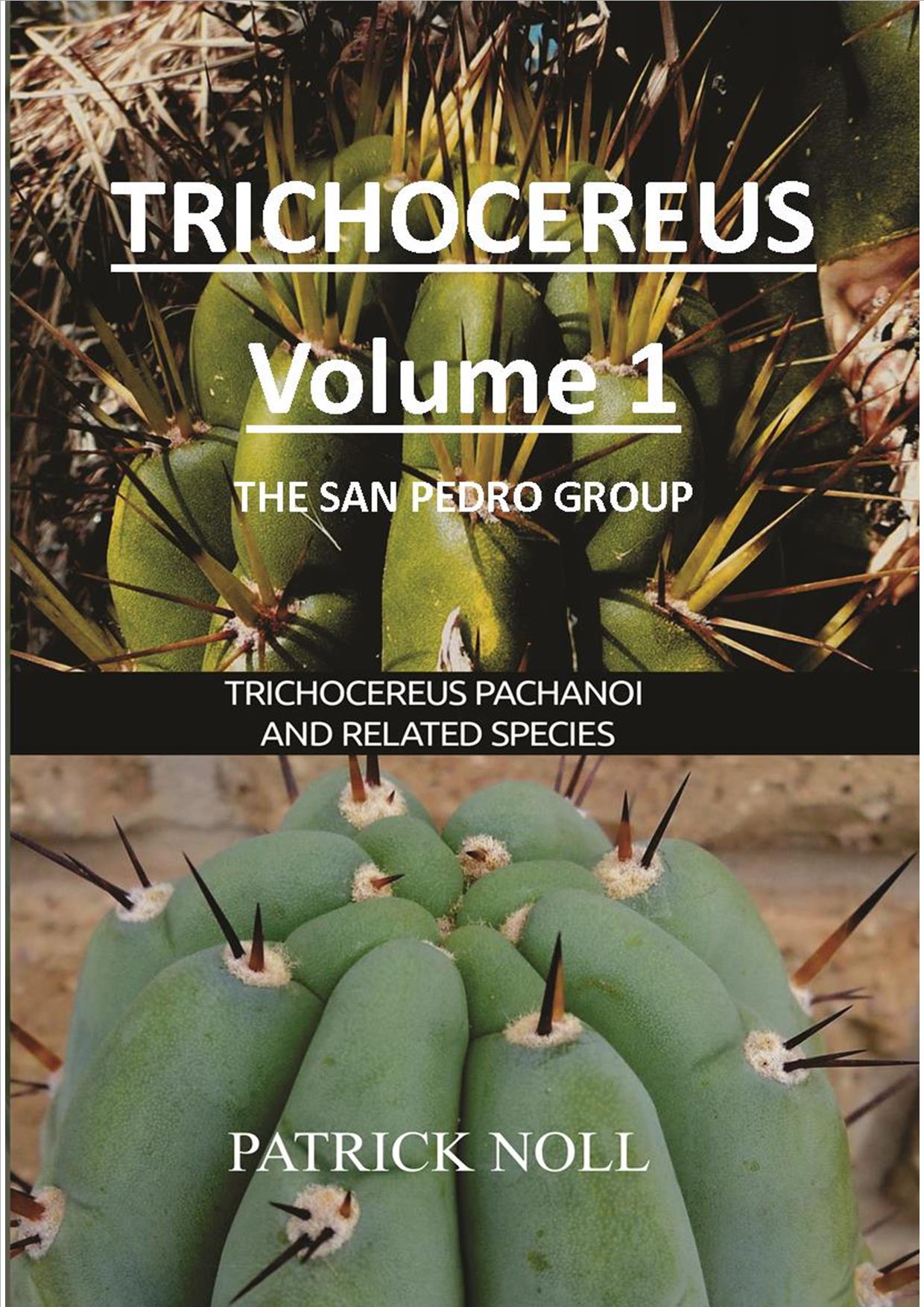
Hi guys, I just wanted to take the time to let you all know about the status of my crowd funding campaign for the printing costs of my book TRICHOCEREUS VOLUME 1: THE SAN PEDRO GROUP. I´ve been working on this book for a few years now and it´s finally getting close to a release date. It´ll have more than 400 all-color pages and will contain hundreds of color pics showing plants from the genus Trichocereus in the habitat, botanic gardens and collections worldwide. There were dozens of well known people helping me with photos for this book and I am extremely proud that I was given the chance to write it! I´ll make sure it´ll be a high quality book that will look awesome on your shelf! There will be descriptions, photos and cultivation advice as well as a detailed guide on how to germinate difficult seed. The book takes a close look at flowers, fruits and old names that are no longer valid. This book contains a whole lot of different species and commercial varieties like Trichocereus pachanoi, Trichocereus peruvianus, Trichocereus bridgesii, Trichocereus scopulicola, Trichocereus tarmaensis, Trichocereus cuzcoensis, Trichocereus huanucoensis, Trichocereus pallarensis and many, many more!
The printing costs are somewhere between 10.000 – 12.000 Euros and that´s why I started the campaign on Indiegogo two days ago. Now after just 2 days, the campaign already reached 50% of its goal and is getting new supporters every single day.
My thanks go out to everyone who supported my campaign…either by buying a copy or just sharing the link or talking about it. I wrote a lot more about the creation process of my book on the campaign page on Indiegogo. You can also buy a copy of it through the following link:
https://trichocereus.net/product/trichocereus-book-vol-1-patrick-noll-buch-cactus-echinopsis
There also are package deals and re-seller packages to make it easier for shops or group-buyers to buy it. The books will be printed in June and the shipping phase begins in June or July. If you are not able to participate in the campaign due to whatever reasons, just let me know and I´ll try to find a way to make it work. It´s important to me that everyone who supports this project will actually get one.
Alright guys, it counts now and if I can´t get the campaign funded, the books won´t look as brilliant as they will when it reaches its goal. So please support this amazing Indie Trichocereus book. The crowdfunding campaign will run for 60 days and I hope to reach the goal within the first 2-3 weeks. If you have any questions or just want to get in touch with me, you can reach me through EG [ät] trichocereus.net. You can also get in touch with me through our Trichocereus Facebook Group!
Montag, 11. Januar 2016
Nitrogen: N1 (Trichocereus bridgesii)
Nitrogen: N1 (Trichocereus bridgesii)
The N1 clone comes from our friend Nitrogen. The pics were all provided by Nitrogen and he used this plant in numerous cross. It is a Trichocereus bridgesii with a massive spination and beautiful golden/orange spines.
The plants I saw have 6 ribs and 3 – 5 long and sharp spines that you really don´t want to get too close to. I am still trying to get flower pics of the N1 and I´ll update this post as soon as I am able to get some. This clone has a much more massive appearance than many other plants with Tr. bridgesii genetics.
In 2012, Nitrogen used the N1 in the following crosses:
TPM x N1
Psycho0 x N1
N1 x TPQC


Nitrogen: N1 (Trichocereus bridgesii)
Freitag, 8. Januar 2016
LC002 - Trichocereus bridgesii
LC002 – Trichocereus bridgesii
This plant is named after a member of the NOOK or SHOOMERY forum called Liberty Caps, who spread seeds involving LC001 and LC002 many years ago. All the plants grown from those crosses are NOT clones, but hybrids between Tr. pachanoi x Tr. bridgesii (LC001) and Trichocereus bridgesii x Tr. pachanoi (LC002).
Please note that this was quite a while ago and I assume it must have been around 2007 or 2008 when Liberty Caps gave away his seeds.
Though the LC002 mother plant looks highly unusual, it´s most likely a Tr. bridgesii! But I didn´t find so many pics myself; so please contact me if you happen to have pics of any of those hybrids.
I received some seeds back in 2008 or 2009, but was not able to get them to germinate because it´s been a while since they were traded around. On the internet, there only is very little information to be found about LC001 and LC002 and almost any source I found just talks about germinated some of this LC001 Trichocereus pachanoi x Trichocereus bridgesii and LC002 Trichocereus bridgesii x Tr. pachanoi seed.
This plant was grown by a SAB member in Australia and it´s very possible that offspring from the same cross looks a little bit different. So technically, this is not a clone but one of the plants that grew from the seed labeled LC002.
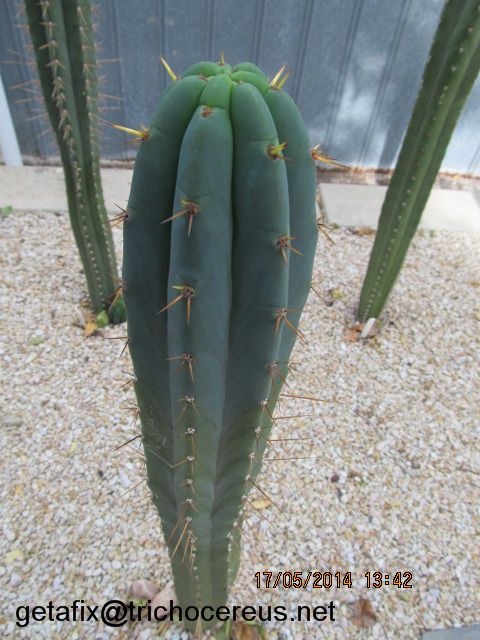
LC002 - Trichocereus bridgesii
Dienstag, 29. Dezember 2015
Jeans (Trichocereus bridgesii)
Jeans (Trichocereus bridgesii)

This interesting plant is a Trichocereus bridgesii clone that was originally sourced by the Australian SAB member Sir Jeans, who gave this clone to a handful of people. By sharing this clone over the course of various years, it was distributed into the collections of many people.
This picture was posted by Sir Jeans in 2012. It shows his original mother plant, which looks like a very spiny plant that almost looks like a Tr. cuzcoensis. Copyright: Sir Jeans

Definitely an interesting plant with long spines and a very glaucous Epidermis. It´s not really completely untypical for a Tr. bridgesii, but it´s definitely one of the most impressive ones out there!
Pictures provided by ZED240!


Jeans (Trichocereus bridgesii)
Chemical Shaman´s D*ck (Trichocereus bridgesii)
Chemical Shaman´s D*ck (Trichocereus bridgesii) (UPDATE DEC 2015)
NO, that is not supposed to read „DUCK“. 😉
Chemical Shamans D*ck aka CSD is a new Clone that was introduced by SAB Member Ferret, who brought it into circulation in honor of the Member Chemical Shaman, who unfortunately passed away.
According to Ferret, the Clone was grown from a batch of Trichocereus bridgesii Seed, which were provided by the NOOK Member BEEKER.
The Clones Characteristics are a very stunted, almost monstrous Look with a very unique Spination, which is very unlike other Trichocereus bridgesii. Besides, if seen from above, the Plant has a Look that reminds of a Lophophora williamsii, which is WAY COOl!
At this point, we couldn´t observe a flower yet, but will certainly add Flower Pics as soon as we get some.
The copyright on all those pics belongs to SAM, who donated those pics for the database!


UPDATE December 2015:


Chemical Shaman´s D*ck (Trichocereus bridgesii)
Bruce - Trichocereus bridgesii
Bruce – Trichocereus bridgesii
BRUCE is a beautiful Trichocereus bridgesii with very broad ribs and a funny spination. Just like many other, BRUCE is a hybrid of Australian origin. Because of the broad ribs, this plant tends to have relatively few ribs. Most plants I´ve seen had between 4 and 6 ribs. The mother plant goes back to the SAB member BLACKDRAGON, who had a giant monster of this amazing plant growing in his garden. He also managed to get it to flower and the flower was relatively typical for a Tr. bridgesii.
BRUCE is said to be somewhat related to the Tr. bridgesii clone EILEEN, that was growing in front of reshroomED´s house. Personally, I would not be surprised if both were grown from similar or the same seed lots. But that´s just speculation and I have yet to hear more detailed information on the background of BRUCE. The plant is also known to show a „melting“ look from time to time, which indicates that this is (at least partially) mutated somehow. BRUCE comes from South Australia and is also very similar to the clone MBN95/ SUPER BRIDGE, which more or less lost as I do not know of anyone who has that plant with an intact label.


BRUCE: COPYRIGHT: GOT

Where to buy cuttings or seeds of BRUCE (Trichocereus bridgesii)?
BRUCE is one of the rarer hybrids from Australia and I know of no breeder that is currently breeding with it. You might try to make a posting at the SAB forum, cactusforum.org or in our Trichocereus Facebook Group!
Bruce - Trichocereus bridgesii
Montag, 28. Dezember 2015
Lumberjack (Trichocereus bridgesii)
Lumberjack (Trichocereus bridgesii)


Pics: NITROGEN

The LUMBERJACK clone or LUMBERJACKUS is a rare and sought after Trichocereus hybrid. Its actually a Trichocereus bridgesii with very distinct and distinct traits. It has a very typical double-pair spination and usually grows into a very fat plant that flowers abundantly.
The plant was originally found in a Lumberjack store in Sacramento, California. It is believed to be a hybrid between Trichocereus bridgesii and Trichocereus peruvianus. But it´s also possible that this is actually a pure botanical Trichocereus bridgesii, without any other species involved. Plants in nature can look quite distinctly and unfortunately it´s not possible to guess the parents of a certain plant.
The LUMBERJACK clone is really rare and the only grower I know of that is selling seed or cuttings is misplant, who uses his mother plant to make multiple crosses per year.
The plant should be treated just like every other Trichocereus bridgesii and is a very hardy plant.
Those pics are from Misplant´s mother plants. Copyright: Misplant.net. You can buy seeds of the Lumberjack clone on Misplant´s homepage!


Lumberjack (Trichocereus bridgesii)
Abonnieren
Posts (Atom)