Trichocereus pachanoi „Clone Two“ (Aplantis)
The Trichocereus pachanoi „Clone Two“ is a clone that was brought back from Peru by a collector who collected in in 2013 in Huaraz. The plant originally stood beside a Ceviche Restaurant. The owner of this restaurant gave a...
Trichocereus pachanoi "Clone Two" (Aplantis)

Posts mit dem Label Trichocereus Pachanoi werden angezeigt. Alle Posts anzeigen
Posts mit dem Label Trichocereus Pachanoi werden angezeigt. Alle Posts anzeigen
Freitag, 23. Dezember 2016
Trichocereus pachanoi "Clone Two" (Aplantis)

Montag, 7. November 2016
Clone One (Trichocereus pachanoi - Aplantis)
Clone One (Trichocereus pachanoi – Aplantis)
Clone One is a Trichocereus pachanoi clone that was made available by the owner of the website Aplantis.net! The clone was collected in Cajabamba in Peru in 2013. Its main characteristics are the bright green epidermis color and the rather...
Clone One (Trichocereus pachanoi - Aplantis)
Freitag, 4. November 2016
First photos of my first TRICHOCEREUS BOOK!
First photos of my first TRICHOCEREUS BOOK!
Hey guys, the first samples of the Trichocereus book are here. It looks gorgeous and I wanted to share some of the pics with you. Please note that this is a huge book. The measurements are 221 x 303 mm, so it´s even a little bit bigger than A4. Get yourself a ...
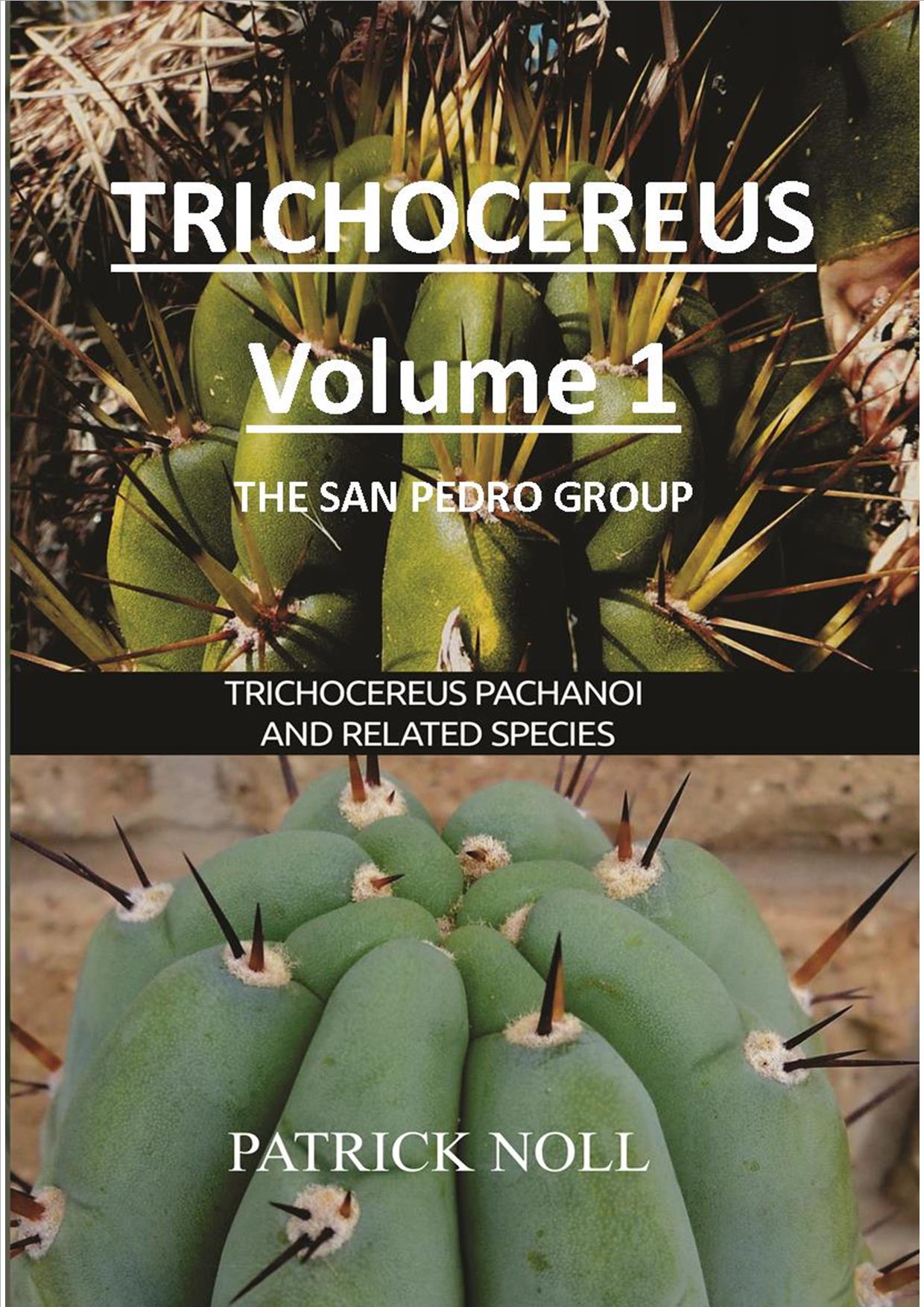 |
| TRICHOCEREUS BOOK: Volume 1 |
First photos of my Trichocereus book!
Freitag, 12. August 2016
Tom Juul´s Giant / TJG (Trichocereus pachanoi)
Tom Juul´s Giant / TJG (Trichocereus pachanoi)
The well known clone TOM JUUL´S GIANT / TJG goes back to the former butcher Tom Juul´s, who imported this plant into the United states.
Photo: Cactusaffinity.com
Tom Juul had a giant plant in his garden and after his death, cuttings of this plant wer...
Tom Juul´s Giant / TJG (Trichocereus pachanoi)
Sonntag, 3. Juli 2016
KK339 Trichocereus pachanoi
KK339 Trichocereus pachanoi
KK339 Trichocereus pachanoi is an Ecuadorian San Pedro!
This wonderful plant is one of the most interesting plants distributed by the Peruvian wholesaler Karel Knize. The species is pretty much the archetype of an Ecuadorian Pachanoi. This type is extremely typical...
KK339 Trichocereus pachanoi
Montag, 2. Mai 2016
Trichocereus huanucoensis
Trichocereus huanucoensis
The first occurrence of Trichocereus huanucoensis goes back to a nursery owner called Harry Johnson senior, who brought this plant into the USA in the 1950s. Unlike popular belief, Trichocereus huanucoensis is NOT an official species. There is no official description an...
Trichocereus huanucoensis
Freitag, 22. April 2016
The PC Trichocereus clone- What the heck?
The PC Trichocereus clone- What the heck?
I wanted to clarify some things about the PC Trichocereus clone. What it is, where it probably is from and what it isnt. The name is probably the most overused name in the history of Trichocereus culture. I personally hate it and spent days discussing...
The PC Trichocereus clone- What the heck?
Trichocereus Parque de las Leyendas. Peru
Trichocereus in Parque de las Leyendas. Peru
Trichocereus Parque de las Leyendas:
The Parque de las Leyendas is located in the San Miguel district of Lima and was founded as the first Zoo of Peru. Peru is one of the most biologically diverse countries in the world and the park is home to countless amazing plants and creatures, including some interesting Trichocereus species.
There are many cool Trichocereus in the Parque de las Leyendas in Peru. Ben Kamm and his friends from Sacredsucculents.com visited the park during various field trips, collected some seeds and made some photos. Here are some of the pics:
Read the full version of this article here on our site. It has all the photos and we update our articles all the time:
https://trichocereus.net/trichocereus-parque-de-las-leyendas
BK08611.4 Trichocereus pachanoi, Jardin Botanico, Trichocereus Parque de las Leyendas, Lima, Peru
BK08611.5 Trichocereus Parque de las Leyendas, Lima, Peru
Another Trichocereus Pachanoi from the PARQUE DE LAS LEYENDAS in Lima Peru! Same Location, different Plant.
And this is a plant that was grown from the Sacred Succulents Field Trip seed. Copyright: Stillman.
The very long spines are really interesting because they are nothing like the almost spineless appearance of the mother plant. Nonetheless, it´s actually quite common for old plants to be pretty spineless. It´s also interesting because the plant has very few ribs and a large distance between the areoles.
Where to buy seeds or plants of the BK08611.5?: Well, the plant was visited during a field trip and Sacred Succulents sold seeds coming from that plant for a while. So far, the plant shown in the picture above is the only plant I saw so far and it´s definitely very spiny if you compare it with the almost spineless mother plant. Every now and then, someone (mostly from the USA & Australia) is giving away a cutting of this type in our Trichocereus Facebook group, because there were quite a few people who were able to get their hands on seeds. If you are looking for this type, I´d recommend you to send a message to Sacredsucculents.com, because it´s possible they still have some available. Apart from that, you need a lot of luck to find one of them on the open market. But even if you shouldn’t manage to get one, you can get a Trichocereus cordobensis/Super Pedro, which is a very similar type that´s known from Australia. I sometimes have seeds available and if you are interested in getting some, let me know.
BK08611.6 Trichocereus pachanoi, Jardin Botanico, Parque de las Leyendas, Lima, Peru
As far as I know, Ben also visited those Trichocereus pachanois during the 2014 Field Trip! So in case you bought some Pachanoi seeds starting with BK14, it´s very possible those are the mother plants!
Trichocereus Parque de las Leyendas. Peru
Dienstag, 19. April 2016
Chavín de Huántar: Trichocereus
Chavín de Huántar: Trichocereus
Chavín de Huántar is an archaeological site in Peru with a long history of Trichocereus & San Pedro cultivation. There are plants that can be found within the ruins of Chavin and those plants probably go back for many thousands of years. The ruins are thought to be from 1200BC and the age of this complex is energically discussed among archaeologists.
Chavin is located in the Ancash area and holds great religious as well as historic significance, which is why the center was in the midst of the Chavin culture. Chavín de Huántar is located near the important Peruvian city Lima and lies at the confluence of two large rivers: The Rio Mosnar and the Huanchecsa river. Chavin has a great botanic variety and is home to a large number of different plants and Trichocereus species.

You can find the full version of this article, including the most recent updates and photos here:https://trichocereus.net/chavin-de-huantar-trichocereus-santaensis-el-lanzon
Photos from the Sacred Succulents Field Trips. Ben Kamm, Sacredsucculents.com.
Trichocereus sp, Chavin, Ancash, Peru
The type that is usually known from Chavin De Huantar is probably somewhere between Trichocereus cuzcoensis and Trichocereus peruvianus. We saw plants that clearly belonged into the San Pedro & Trichocereus pachanoi group as well as other weird plants…some of which even look like Trichocereus huanucoensis.
BK09509.2 Trichocereus sp, Chavin, Ancash, Peru
Another great Specimen from the Ancash Region. Chavin in Peru.
BK09508.2 Trichocereus sp, Chavin, Ancash, Peru 2009
BK09509.1 Trichocereus sp, Chavin, Ancash, Peru
BK09509.1 Trichocereus sp, Chavin, Ancash, Peru 2009
This legendary photo is made by Aplantis.net:
Photo: Aplantis.net
This plant has a great history and most people who visit the area can´t go by without taking loads of photos. It´s one of my most favorite plants.
Those plants were posted by Chavin Herbalist. They are trying to preserve the Chavin genetics and posted some amazing photos on Facebook. Check them out!
Donnerstag, 31. März 2016
HB01 (Trichocereus puquiensis)
HB01 (Trichocereus puquiensis)
Trichocereus HB01 is a clone that originally comes from the Australian Shop HERBALISTICS. The plant was sourced from a garden in the Australian city Gatton in Queensland. The clone is usually short spined, but can get more spiny at a larger size.
I originally described this clone as some kind of Tr. peruvianus. Looking back, this was probably not the case. Through my extensive research for my book, I spent a lot of time researching Trichocereus puquiensis and I feel like the HB01 clone is very similar to what I know as Tr. puquiensis from Ritter´s old description. It basically is a long-spine Pachanoi that tends to have a higher number of ribs. Tr. puquiensis has usually 8 – 10 ribs and the pics that I got from the SAB member LHB2444 it definitely fits the description. It also has the orange spines that do NOT have swollen spine bases. That´s actually very typical for Tr. puquiensis as well.


The photos below (Zed240) show a plant that was labeled HB01 but looks a little bit different and has substantially longer spines as the one in the first two pics. That being said, there is a great variability within all the Trichocereus species, so I would not be surprised if that difference in spine length is caused by environmental factors. There also are 5 – 6 ribbed plants from Puquio and this second plant might be one of them. But no matter if the HB01 clone is actually a Trichocereus puquiensis or a Trichocereus peruvianus, it definitely as an amazing plant that will look awesome in your collection. You can find the description and photos of Tr. puquiensis here!


HB01 (Trichocereus puquiensis)
Trichocereus pallarensis
Trichocereus pallarensis

Trichocereus pallarensis is a species that was described by Friedrich Ritter and listed in his WINTER catalogs starting in 1961! I do have most of the old Winter catalogs, but I unfortunately not the ones after 1960. But that´s not a problem as I have a whole lot of other information about Trichocereus pallarensis.
Ritter wrote about this species numerous times. He basically called this plant a „variety of Trichocereus pachanoi“, but described it as a new species just in case. Back then, it was common that botanists or taxonomists wrote new descriptions only based on minor differences, that would only be seen as a regional form by today´s standards.
Trichocereus pallarensis has 3 – 6 radial spines (15 – 50 mm long). Those are brown or honey colored and relatively thin compared with the ones on Trichocereus peruvianus and Trichocereus pachanoi. The middle spines are often missing or there is only one very strong and long middle spine. It is very similar to Tr. pachanoi in regards to the spination and most of the spines are only few millimeters long. The areoles are often very small and those packed areoles usually tend to miss the one middle spine as well.
Flowers: Friedrich Ritter was not able to get a good description of the flower and I am working on one myself. The plant is very rare and if you happen to have a flowering sized one, please let me know so we can improve the flower description. With that said, it comes from the Pachanoi group and is probably almost identical to the one of Tr. pachanoi. The flower is definitely white, but I´d love to measure it some more.
Fruit: The fruit of Trichocereus pallarensis is 5 cm long and 4 cm thick. Covered with GRAY wool.
Seeds: The seeds of Trichocereus pallarensis are identical to the ones on other Tr. pachanoi types.
Origin/ Type locality: Trichocereus pallarensis grows in Llancora, near Cajamarca. Near Pallar (that´s where the name comes from) and east of the cordillera Blanca. Department Ancash at 2.500 – 3.000 meters altitude.
Where to buy Trichocereus pallarensis seeds and plants:
Trichocereus pallarensis is very rare and only a few shops have them in stock. If you want to buy seeds of Trichocereus pallarensis, please join my seed list and I´ll let you know next time I have some. You can also get some fresh seeds from Sacredsucculents.com every now and then. They have a beautiful number of crosses that they produce every year. You might also be able to get some from Cactusaffinity and Misplant.

Trichocereus pallarensis FR1468 Locality: Machar, Peru (Ritter)
Trichocereus pallarensis
Samstag, 12. März 2016
Crowdfunding Campaign TRICHOCEREUS VOLUME 1
Crowdfunding Campaign TRICHOCEREUS VOLUME 1
Hi guys, I just wanted to take the time to let you all know about the status of my crowd funding campaign for the printing costs of my book TRICHOCEREUS VOLUME 1: THE SAN PEDRO GROUP. I´ve been working on this book for a few years now and it´s finally getting close to a release date. It´ll have more than 400 all-color pages and will contain hundreds of color pics showing plants from the genus Trichocereus in the habitat, botanic gardens and collections worldwide. There were dozens of well known people helping me with photos for this book and I am extremely proud that I was given the chance to write it! I´ll make sure it´ll be a high quality book that will look awesome on your shelf! There will be descriptions, photos and cultivation advice as well as a detailed guide on how to germinate difficult seed. The book takes a close look at flowers, fruits and old names that are no longer valid. This book contains a whole lot of different species and commercial varieties like Trichocereus pachanoi, Trichocereus peruvianus, Trichocereus bridgesii, Trichocereus scopulicola, Trichocereus tarmaensis, Trichocereus cuzcoensis, Trichocereus huanucoensis, Trichocereus pallarensis and many, many more!
The printing costs are somewhere between 10.000 – 12.000 Euros and that´s why I started the campaign on Indiegogo two days ago. Now after just 2 days, the campaign already reached 50% of its goal and is getting new supporters every single day.
My thanks go out to everyone who supported my campaign…either by buying a copy or just sharing the link or talking about it. I wrote a lot more about the creation process of my book on the campaign page on Indiegogo. You can also buy a copy of it through the following link:
https://trichocereus.net/product/trichocereus-book-vol-1-patrick-noll-buch-cactus-echinopsis
There also are package deals and re-seller packages to make it easier for shops or group-buyers to buy it. The books will be printed in June and the shipping phase begins in June or July. If you are not able to participate in the campaign due to whatever reasons, just let me know and I´ll try to find a way to make it work. It´s important to me that everyone who supports this project will actually get one.
Alright guys, it counts now and if I can´t get the campaign funded, the books won´t look as brilliant as they will when it reaches its goal. So please support this amazing Indie Trichocereus book. The crowdfunding campaign will run for 60 days and I hope to reach the goal within the first 2-3 weeks. If you have any questions or just want to get in touch with me, you can reach me through EG [ät] trichocereus.net. You can also get in touch with me through our Trichocereus Facebook Group!
Montag, 11. Januar 2016
Sausage Plant (Trichocereus peruvianus)
Sausage Plant (Trichocereus peruvianus)
The Sausage Plant is a very blue type of short spined Trichocereus peruvianus or some kind of Pachanoi / Peruvianus intermediate. The name comes from the „sausage-like“ growth. It has the tendence to terminate its growth and pup again on top of the old shoot. That look can sometimes make them impression of a sausage.
SAUSAGE PLANT originally comes from South Australia, but there also are other sites where it can be found. That also includes the Fields collection.
Unfortunately, I do not have a good pic of this pupping behaviour, but it´s been reported from various growers that own it. It definitely is one of the most interesting Tricho clones out there and exceedingly rare in cultivation.
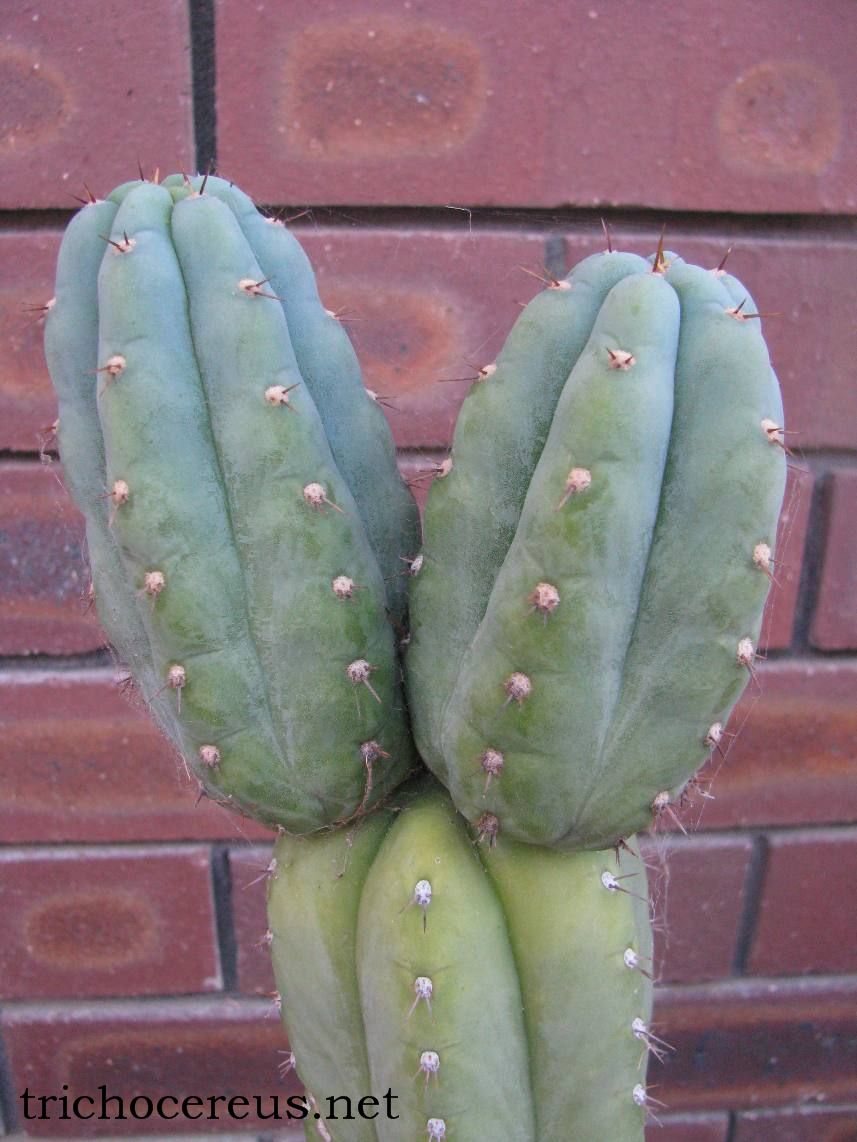
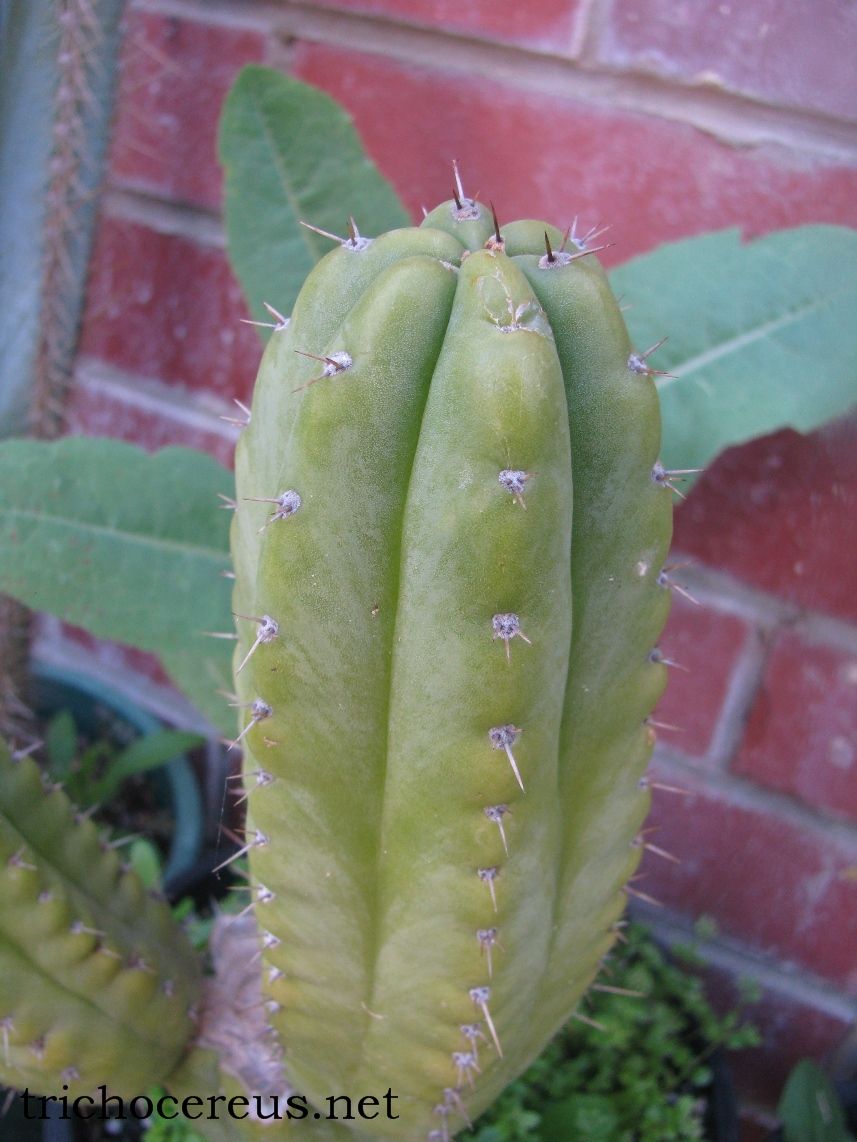

Pics: GoT
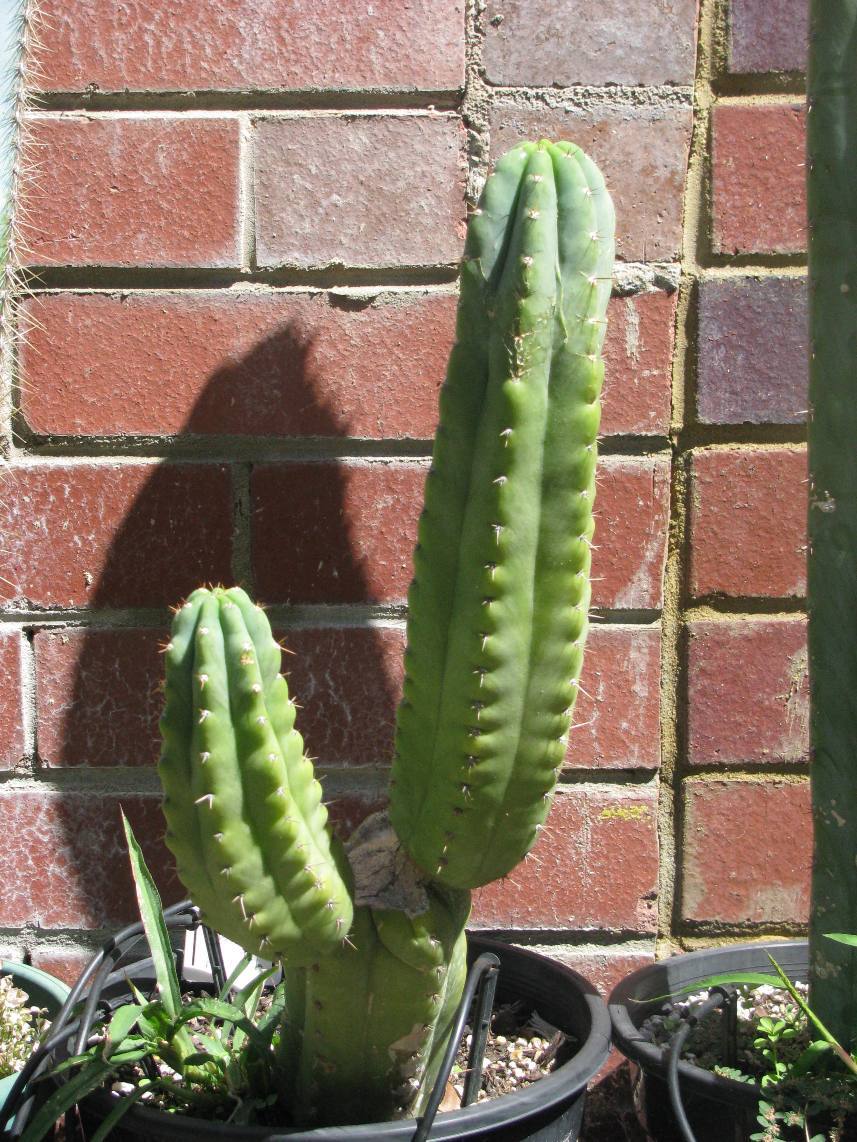
This is a Sausage Plant x Trichocereus Scopulicola
Sausage Plant (Trichocereus peruvianus)
Freitag, 8. Januar 2016
LC002 - Trichocereus bridgesii
LC002 – Trichocereus bridgesii
This plant is named after a member of the NOOK or SHOOMERY forum called Liberty Caps, who spread seeds involving LC001 and LC002 many years ago. All the plants grown from those crosses are NOT clones, but hybrids between Tr. pachanoi x Tr. bridgesii (LC001) and Trichocereus bridgesii x Tr. pachanoi (LC002).
Please note that this was quite a while ago and I assume it must have been around 2007 or 2008 when Liberty Caps gave away his seeds.
Though the LC002 mother plant looks highly unusual, it´s most likely a Tr. bridgesii! But I didn´t find so many pics myself; so please contact me if you happen to have pics of any of those hybrids.
I received some seeds back in 2008 or 2009, but was not able to get them to germinate because it´s been a while since they were traded around. On the internet, there only is very little information to be found about LC001 and LC002 and almost any source I found just talks about germinated some of this LC001 Trichocereus pachanoi x Trichocereus bridgesii and LC002 Trichocereus bridgesii x Tr. pachanoi seed.
This plant was grown by a SAB member in Australia and it´s very possible that offspring from the same cross looks a little bit different. So technically, this is not a clone but one of the plants that grew from the seed labeled LC002.
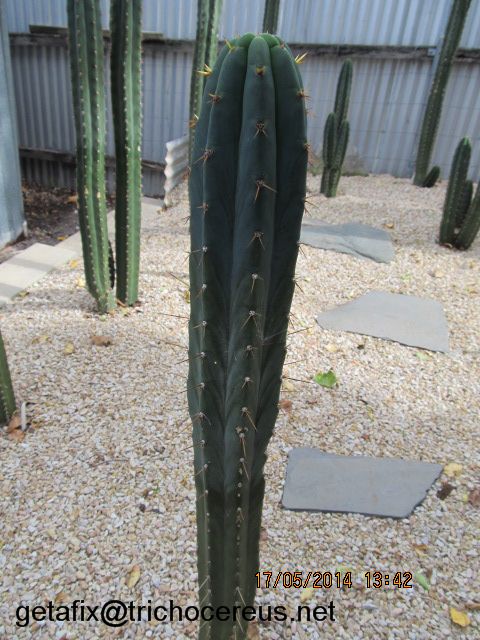
LC002 - Trichocereus bridgesii
Mittwoch, 6. Januar 2016
Omar (Trichocereus)
Omar (Trichocereus / Echinopsis)
Omar is a Trichocereus clone from Australia.
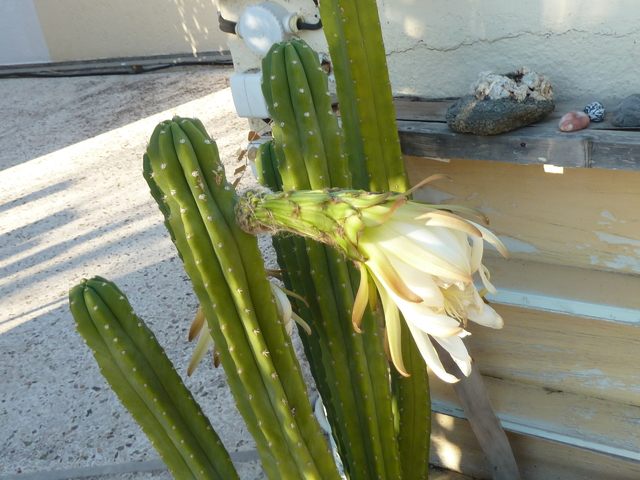
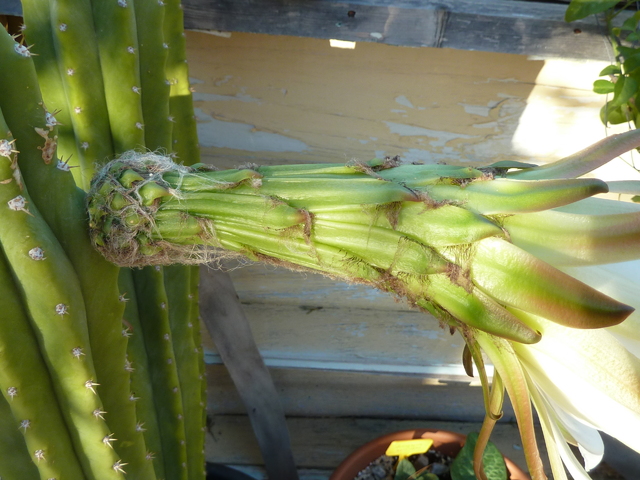
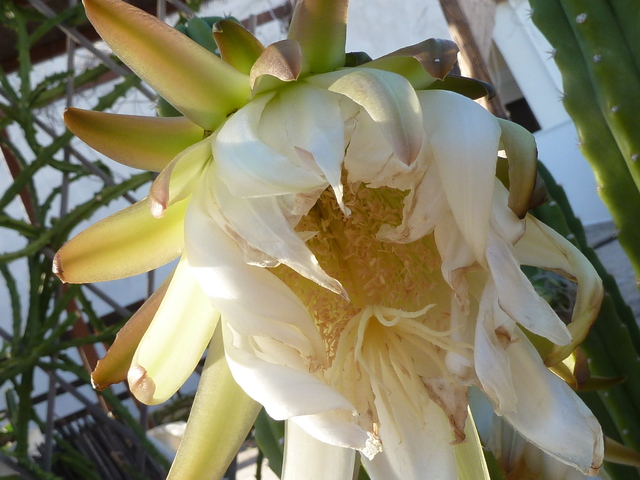

OMAR is a Trichocereus pachanoi clone that was most likely brought into circlulation by the former SAB members REV or Gomaos. The plant was also offered by the SAB shop, where it was sold alongside a similar hybrid called ALF. That leaves room for speculation and it´s possible that both plants (OMAR & ALF) were grown from the same seed pod or at least, were representatives of the same regional type. I personally have trouble looking at OMAR without seen anything but the well known PC Pachanoi „clone“, which is probably Friedrich Ritter´s TRICHOCEREUS RIOMIZQUENSIS from Bolivia. This PC (short for predominate cultivar, as it is the most common type of Pachanoi throughout North America) is widely distributed all over Australia as well.
OMAR has the same yellowish look that almost all Tr. riomizquensis had in common. Besides, the areoles and the small stump spines are really typical. And on top of that, it has the same type of flower.
Again, I did not have the chance to observe this plant over the course of a few years, but what I´ve seen on some of the pics looks a lot like the predominate cultivar.
https://trichocereus.net/omar-trichocereus-echinopsis-pc-predominant-cultivar
CLONE TWO - (Trichocereus / Echinopsis) clone
CLONE TWO - (Trichocereus / Echinopsis) clone

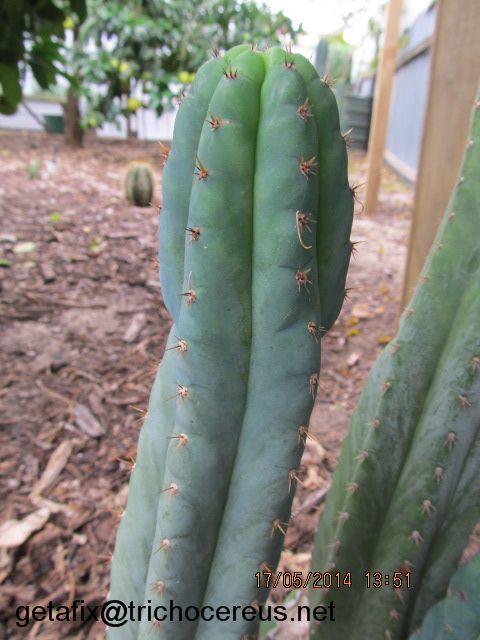
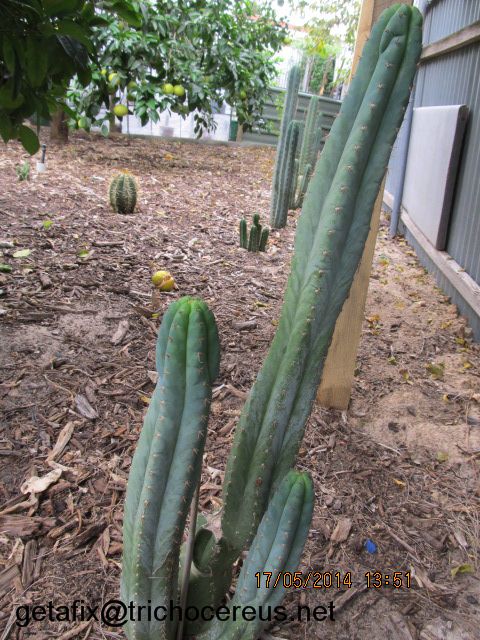
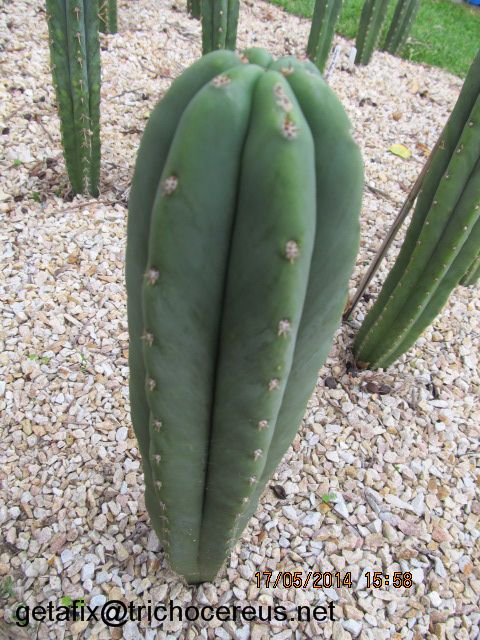
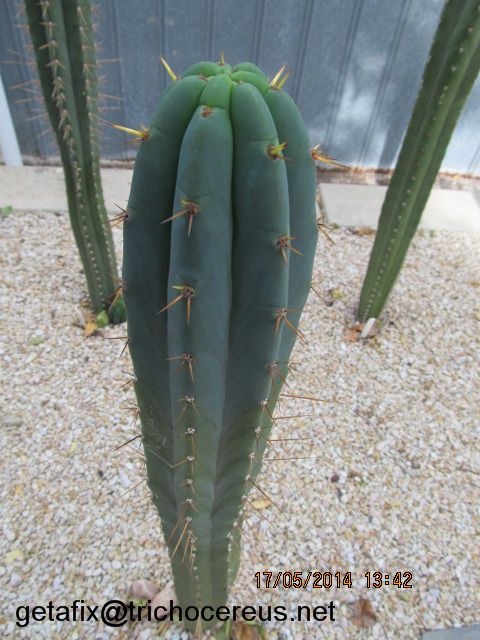
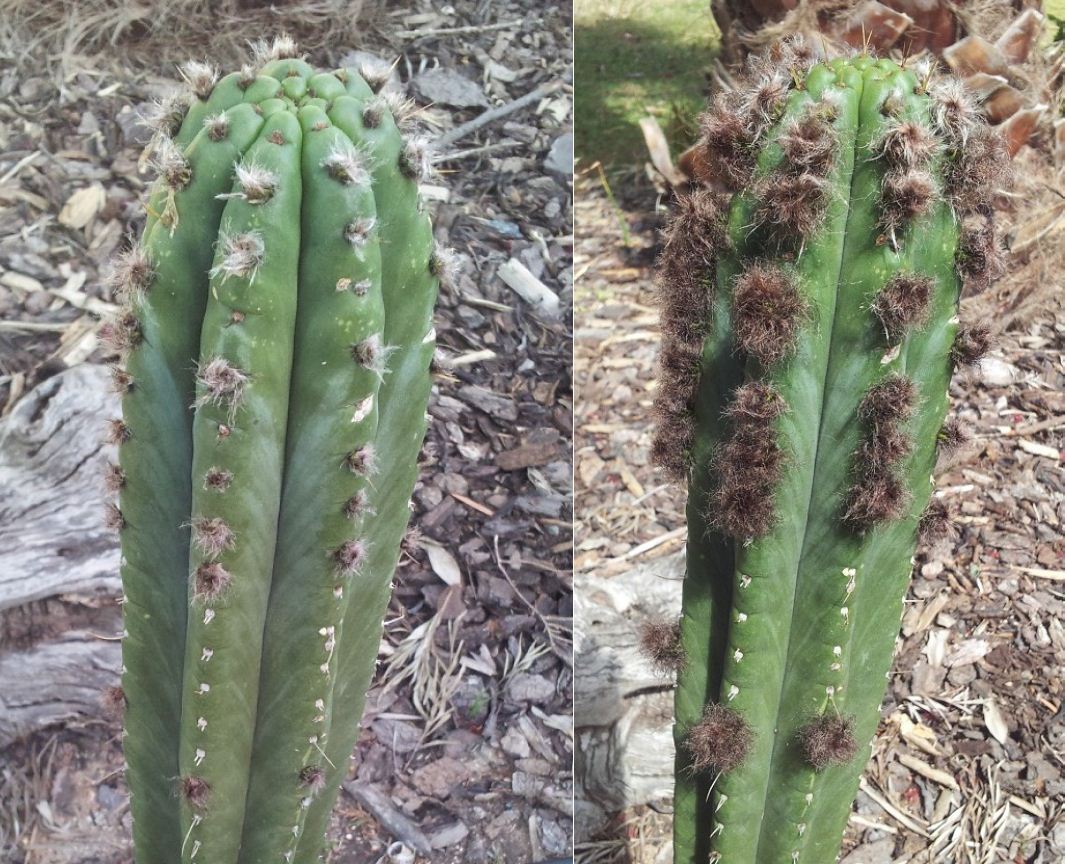
CLONE TWO is another cool clone that was sourced by the European breeder Aplantis. It looks very much like CLONE ONE and depending on the conditions it is grown in, it might really hard to keep the two apart. CLONE TWO comes from Huaraz, which is the home of many beautiful Pachanoi clones, such as the so-called Trichocereus Huarazensis. The plant was located in front of a Restaurant and when the owner wanted to remove it, Ogun jumped on the opportunity to get some cuts for the grower Community. Aplantis called it „a little bit more feminine“ than CLONE ONE. This one ist not as bright green as CLONE ONE and has a slight touch of gray. The areoles are more hairy than the ones on CLONE 1 and has very strong V-notches above the areoles. The offshoots usually have 6 – 7 ribs and tend to have a green/blue or glaucous color. The plants I´ve seen were a little bit fatter than the ones from CLONE ONE, but that also depends on the environment and it´ll take a few years to say more about the growth habits of this beautiful plant.


Ogun: CLONE TWO (Trichocereus pachanoi)
Dienstag, 5. Januar 2016
Ogun: CLONE ONE (Trichocereus pachanoi)
Ogun: CLONE ONE (Trichocereus pachanoi)

This beautiful Pachanoi is/was distributed by the SAB member Ogun. It has a beautiful bright green epidermis and short stump spines. The plant comes from Cajabamba in Peru and one of its charasteristics is the bright green color. Most of the colums we saw had 6 – 7 ribs, but it´s very possible that new pups differ from that. CLONE ONE looks very healthy and vigorous. If you look very closely, you can see some very fine grains on the epidermis and the shield-shaped areoles are covered with a brown fluff. The clone also has some very strong V-notches, making it a very typical Tr. pachanoi. In a way, it also resembles the Ecuadorian Pachanois.
Flower: Unfortunately, we weren´t able to observe the flower yet but I´ll keep you updated in case I´ll come across a flowering plant for the database.
Where to buy seeds or cuttings: I´ll probably try to get cuttings as soon as they are available. The clone is fairly new in cultivation, which is why it will take 3-5 years until some of them are flowering. I´ll keep you guys updated in case I get anything.


Ogun: CLONE ONE (Trichocereus pachanoi)
Dienstag, 29. Dezember 2015
Trichocereus pachanoi BOGAN
Trichocereus pachanoi BOGAN
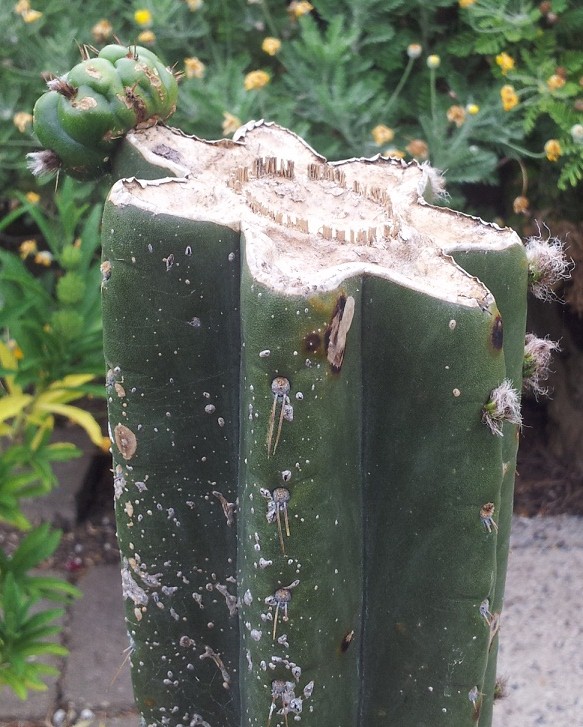
The Bogan clone has 0ne of the funniest backgrounds of all the clones that are known in the community. It all goes back to the year 2006, when the SAB Member DuG discovered a very cool type of (back then, suspected Trichocereus macrogonus) growing in front of a house. He initially asked for a cutting (which he was lucky enough to get) and next time he got there, he realized that the large motherplants had been hacked down by the „bogan“ homeowners. And not only had they hacked them down, but they also tried to burn them. He immediately asked if he could take them with him and they were more than happy to get rid of them…because…you know, cacti don´t burn so well. Here is DuG´s original picture on SAB just to show you how they were looking back then.


Copyright DuG, have a look at the complete Thread on SAB here!
Well yeah, and the plant was passed down from DuG to many other SAB members, of which some of them still grow them today. Copyright Prier.
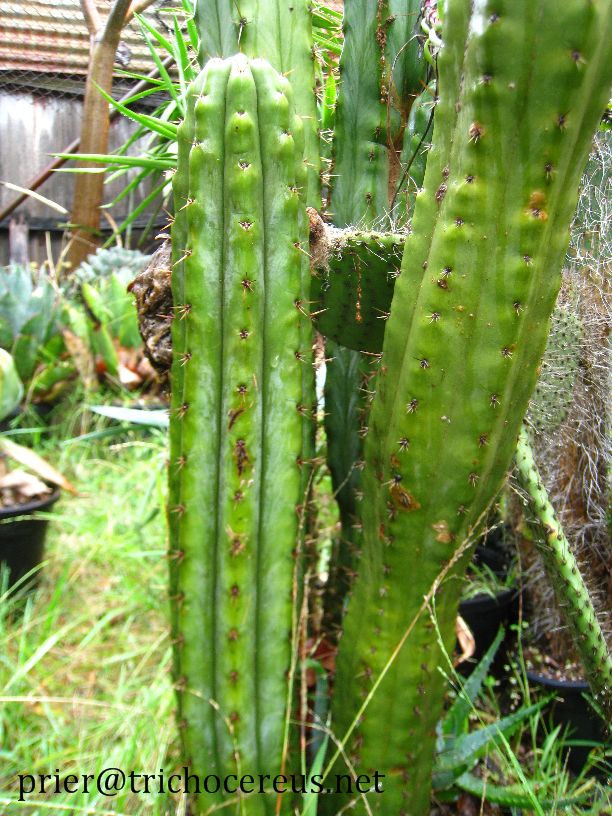

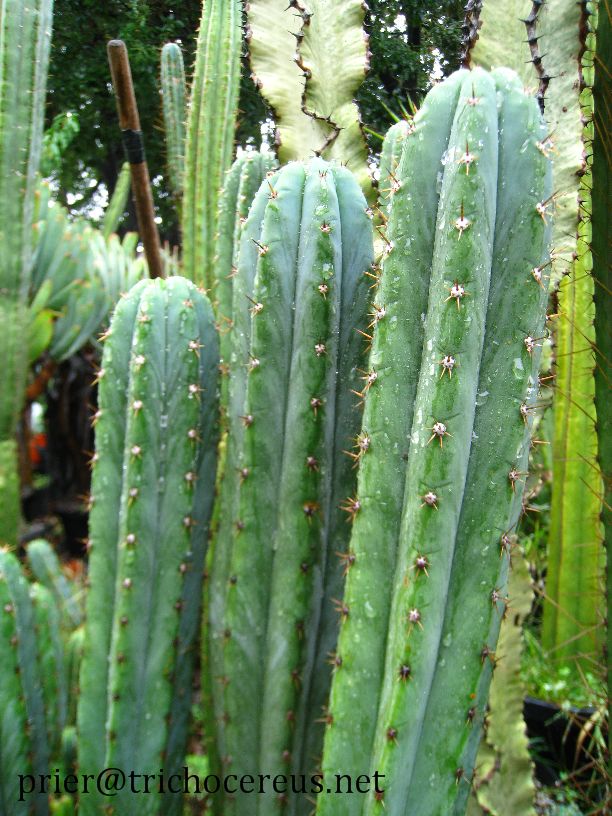
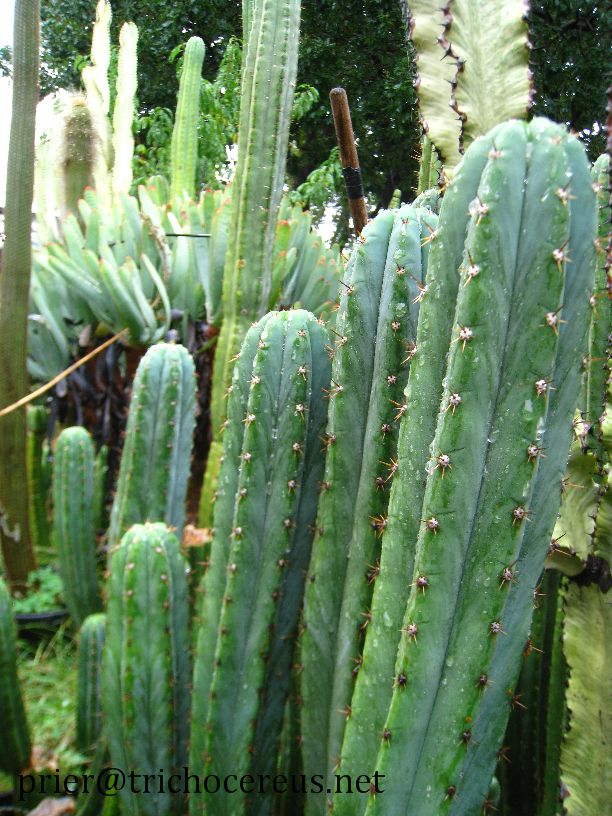
So far, I havent seen a flower pic but I will certainly update this page as soon as I get some. The plants usually have a very bright green epidermis and look very much like the Ecuadorian types. On the earlier pics, they looked a lot more like a peruvianus, but this clone shows it´s genetics on the young growth. But for a pachanoi, it can get very long spines and it definitely is a very cool plant!
Where to buy seeds or plants: Well, I am currently not aware of any real sources for this plant, but I hope to get some seeds sometime soon.. You can ask the SAB customer service to find out if they have any of them in stock. But apart from that, I´d make a posting at SAB or our Trichocereus Facebook Group and ask about them. Because DuG gave away quite a few of them and there still are breeders who have them in their collection.
Trichocereus pachanoi BOGAN
Montag, 28. Dezember 2015
YOWIE (Trichocereus Pachanoi)
YOWIE (Trichocereus Pachanoi) – Named Clone Database


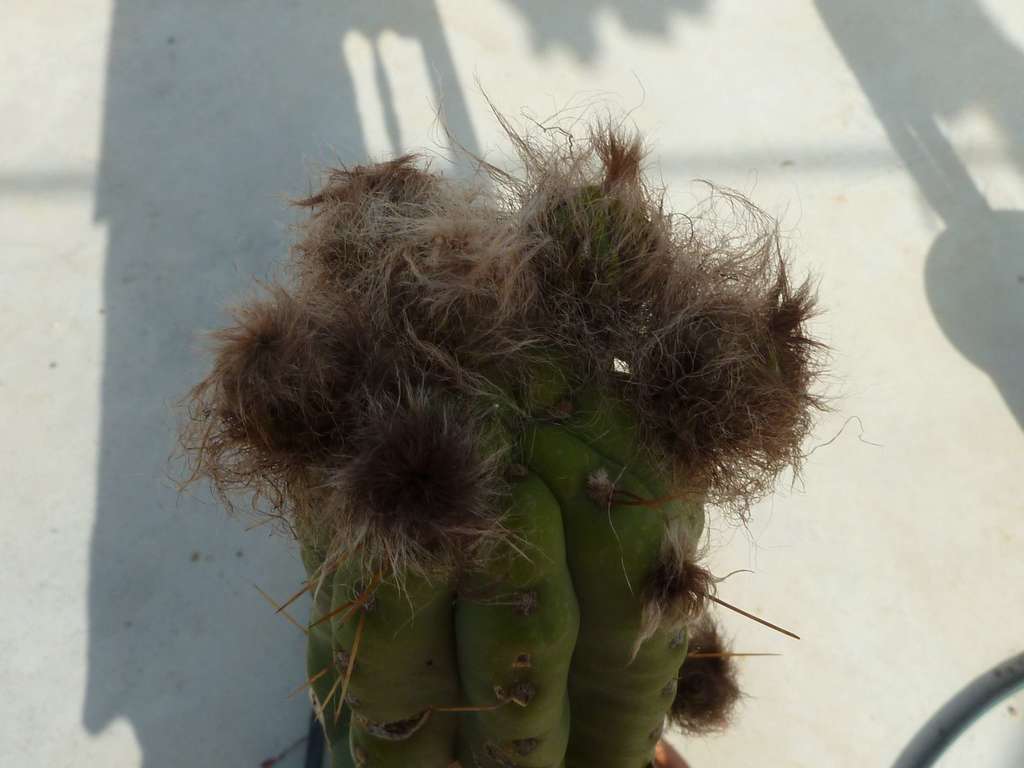
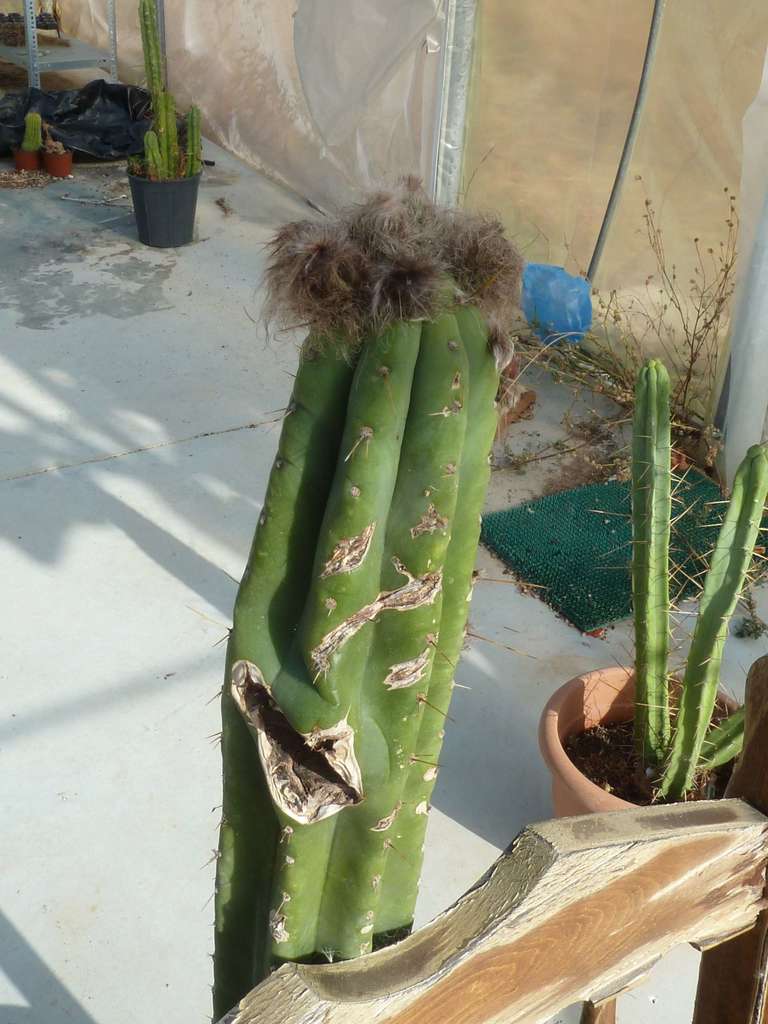
Yowie is a very cool and popular Trichocereus Pachanoi with a unique Spination that consists of two parallel Spines per Areole. It also has very pronounced ribs and looks very much like an Ecuadorian Pachanoi. Now let me add some information about where this clone came from.
The Yowie clone originated in Yarrawonga Victoria. The SAB member Marsha (who was previously known by the username „Yowie“ led PD to the property where the mother plant of this clone grew. This clone is also part of the Fields collection, where many amazing clones came from. The clone is easily recognized by the pair of spines, that makes it very different from other Pachanois. However, similar plants can be found all across Australia (and the world), so it´s not really sure if Yowie is actually a clone or just represents a local type. I know similar (and almost identical) Pachanois, especially from Ecuador and it may be very well possible that they are not genetically identical to the Yowie clone. If you encounter similar plants, you can just test it by trying to breed it with a verified Yowie. If you are not sure about the ID of your plant, feel free to post in on SAB or our Trichocereus Facebook Group!
Where to buy Yowie seeds or plants?: This clone is really rare and only shows up every now and then on sales in the SAB forum or our Facebook group. I am currently not aware of any breeders that actively breed with it though there are some cuttings available every now and then. Those hybrids originated in Australia (which has very strict import and export laws), what makes them very rare throughout other parts of the world. For everyone who owns or is looking for some Yowies, I would recommend making a posting in the group or the SAB forum.


Pic: Prier

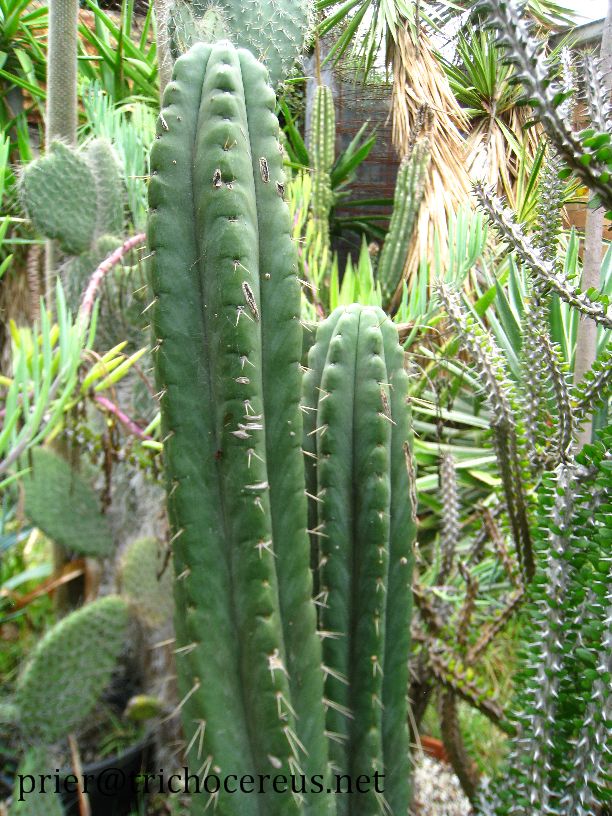

Pic: Gus Freeman
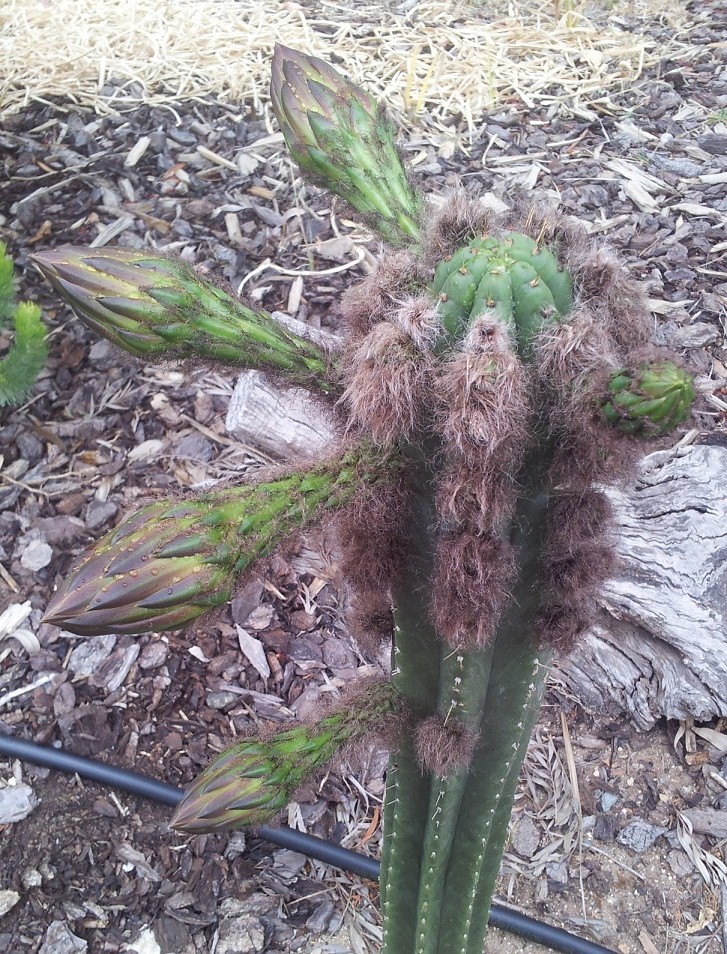
YOWIE Trichocereus Clone Echinopsis pachanoi Trichocereus clone Echinopsis pachanoi
Abonnieren
Posts (Atom)